Advertisement
Advertisement
September 2013 Supplement
Overcoming the Challenges of Access and Seal
The Arizona Heart experience with the Ovation Prime™ stent graft system.
By Venkatesh G. Ramaiah, MD, FACS; Ayman Jamal, MD; and Mohammed Jabr, MD
There have been significant advances in the devices used for the endovascular treatment of infrarenal abdominal aortic aneurysms (AAAs) since Dr. Parodi's first description in 1990. Currently, there are eight infrarenal devices approved by the US Food and Drug Administration to treat AAAs. Conventional wire scaffolded infrarenal endografts appear to have reached their technological plateau, and it is apparent that there is little room for any substantial or meaningful improvements to be made to these grafts.
Devices have tackled migration issues with suprarenal fixation, active fixation, and anatomical fixation. They attempt to continue to improve the profile of the devices, although this may have a limiting factor or involve unappealing trade offs. As the metal and the graft materials used in the construction of these devices thin out, they lose some of the radial force needed in the sealing zones. To accommodate the current challenges of hostile necks and access issues, any new technology would need to embrace an innovative “out-ofthe- box thinking” philosophy.
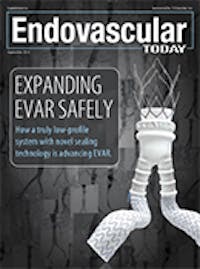
The Ovation™ stent graft system (TriVascular, Inc., Santa Rosa, CA) received premarket approval from the US Food and Drug Administration for the treatment of infrarenal AAA in October 2012, and the Ovation Prime stent graft system received subsequent premarket approval in December 2012, which improved upon the delivery system attributes to further enhance ease of use. This novel graft is an ultra-low-profile, modular endovascular graft characterized by a 14-F–outer diameter (4.7-mm) delivery system catheter, which makes it the lowest-profile commercially available system for EVAR. The Ovation Prime graft employs an active suprarenal fixation component and innovative polymer-filled proximal rings that allow sealing in short (≥ 7 mm) proximal necks. Unlike conventional wire and fabric grafts that employ an oversized selfexpanding stent to push fabric against the arterial wall to achieve seal, the Ovation Prime graft employs customizable O-rings, which are filled at low pressure (1 atm), to achieve seal. Although this gasket-like seal is novel in the context of EVAR devices, O-rings are the gold standard in applications that require sealing liquid or gas flow in all other applications. By resolving the challenge of delivering an O-ring seal through a catheter, TriVascular has created many interesting possibilities for sealing in complex anatomies with the Ovation Prime graft. Furthermore, by adjusting the shape, size, and location of the sealing rings in future iterations, the platform has tremendous room for enhancement relative to infrarenal applications and beyond.
Arizona Heart Institute (Phoenix, AZ) has historically been an early adopter of innovative technology, participates in multiple trials and postmarket surveillance studies, and has developed or been a part of the development of some of the endografts currently approved for use.
With its low profile (14-F outer diameter) and novel sealing technology, the Ovation Prime endograft was designed to overcome the challenges of access and seal. In this article, we present three cases to illustrate our experience with the device in challenging anatomies, as well as a brief preliminary synopsis of our 6-month experience.
ARIZONA HEART PRELIMINARY EXPERIENCE WITH THE OVATION PRIME ENDOGRAFT
Our experience with the Ovation Prime stent graft began on February 8, 2013. Within a 6-month period, we have implanted more than 30 grafts, with a 100% technical success rate; 90% of the procedures have been performed via bilateral percutaneous access. The four procedures that were performed via femoral cutdown were done so due to the patients' body habitus and/or severe femoral artery calcification. One of the four patients preoperatively presented with a chronically occluded external iliac artery that was crossed and stented at the time of implantation of the Ovation Prime stent graft. We have observed one groin complication, a pseudoaneurysm, that was resolved using an ultrasound-guided injection of thrombin.
We have experienced three perioperative type IA endoleaks in three extremely challenging cases. All of the endoleaks were treated and resolved at the time of initial implantation. Two of these endoleaks were resolved by placing a Palmaz® stent (Cordis Corporation, Bridgewater, NJ), and one was resolved by placing coils in the proximal sealing zone between the proximal and distal sealing rings. We have not observed any significant type II endoleaks nor type III, IV, or V endoleaks. There have been zero limb occlusions and zero secondary procedures to date. The average length of hospital stay has been 1.5 days.
DISCUSSION
Although improvements have been made to the commercially available traditional wire and fabric endovascular infrarenal AAA endografts, the concept of manipulating or molding the endograft after insertion makes this innovative technology very exciting and presents opportunities for future iterations. The three case examples in this article illustrate the promise of this novel technology in challenging anatomies. Its ability to enable treatment of the most difficult anatomies is what initially led us to use the device. We have since adopted it as our primary option for endovascular aneurysm repair due in large part to its ease of use and accuracy of deployment, which we have found to be best in class among available endografts. With its ultra-low profile, the Ovation Prime system also facilitates easier closure after implantation via percutaneous access, which has become our preferred treatment method since incorporating this device into our practice.
Venkatesh G. Ramaiah, MD, FACS, is a vascular surgeon at the Arizona Heart Institute and Hospital in Phoenix, Arizona. He is Director of Research at the Arizona Heart Institute and Medical Director of the Arizona Heart Hospital. He has disclosed that he is a trainer and consultant for TriVascular.
Ayman Jamal, MD, is a consultant interventional cardiologist at the Arizona Heart Institute and Hospital in Phoenix, Arizona. He stated that he has no financial interests related to this article.
Mohammed Jabr, MD, is a vascular fellow at the Arizona Heart Institute and Hospital in Phoenix, Arizona. He stated that he has no financial interests related to this article.
Advertisement
Advertisement