Advertisement
Advertisement
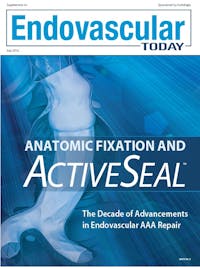
July 2014 Supplement
Sponsored by Endologix
Technological Advances in Abdominal Aortic Aneurysm Treatment With Anatomic Fixation and ActiveSeal™ Platform
Anatomic fixation has become the calling card of Endologix’s AFX® system for treating abdominal aortic aneurysm repair. This technique provides two distinct advantages. First, the distractive or longitudinal migration force on aortic endografts occurs largely as a result of the bifurcation of the endograft. By seating the endograft on the native bifurcation, this force is directly transferred to the patient’s aorta at the bifurcation rather than to the aortic neck. As a result, the design of the endograft in the aortic neck can be solely focused on the other primary requirements of proximal sealing. Second, the advantage of preserving the native bifurcation allows future contralateral access for lower extremity intervention in patient populations with frequent comorbid infrainguinal occlusive disease. The articles in this supplement exemplify the benefits offered by Endologix’s AFX Endovascular AAA System and VELA™ Proximal Endograft systems for abdominal aortic aneurysm repair.
In the first article, Jeffrey P. Carpenter, MD, explains the history and evolution of Endologix devices and how they changed the paradigm for modular endografts from iliac extension to proximal aortic extension, thus retaining the native bifurcation and allowing for proximal endograft designs focused on accuracy and sealing. He also touches on another primary innovation—attaching the graft material only at the top and bottom of the stent frame outside the stent. As a result, the graft material is free to conform to the aortic wall in a broad range of anatomies without the impediment of stent design or configuration. The introduction of the multilayer ePTFE material in the AFX device expanded the ability of the Endologix endograft platform to conform to the heterogeneity of mural disease and nongeometric anatomy that is frequently found in diseased aortas.
The evolution of the endograft design and the conformability of the fabric formed the foundation for ActiveSeal™ technology. ActiveSeal addresses the critical importance of a robust seal in the proximal neck to ensure adequate and definitive aneurysm exclusion. It incorporates both the original design of unrestricted fabric that is free to conform to the wall with the development of multilayer PTFE material with increased, “liquid-like” conformability to the aortic wall. This development further enhanced the ability to conform to the macroscopic effects of atherosclerotic disease on aortic geometry (i.e., noncircular lumens) and the more local effects caused by plaque irregularity and heterogeneity (i.e., ulceration, nonsmooth plaque surfaces, calcification).
Next, Raghu L. Motaganahalli, MD, and Alok K. Gupta, MD, discuss how to overcome thrombus-laden necks. Many current endograft instructions for use warn against use in thrombus-laden necks due to the effect of thrombus on fixation in devices requiring proximal neck fixation and its impact on oversizing and the potential to accelerate proximal neck dilatation. The AFX device avoids these potential impediments through its freedom from the requirement of proximal neck fixation and a wire-form stent structure that incorporates relatively low radial force over a broader range of diameters than other designs. Drs. Motaganahalli and Gupta outline the rationale for using AFX in thrombus-laden necks. By sizing the endograft to the true diameter of the aorta, regardless of the thrombus effect on blood flow lumen diameter, the natural history of thrombus resorption can occur gradually, with the stent “following” the thrombus resorption until it eventually reaches the tissue of the aortic wall. The lower reliance on radial force to establish a proximal seal also means that the thrombus is not disrupted during endograft implantation, avoiding intraoperative embolization of the renal arteries or other critical arterial beds.
This article also discusses how the VELA proximal endograft continues the development of the original Endologix construct of aortic modularity by adding more precision during deployment. It accomplishes this goal through two different mechanisms. First, the new delivery system with the unique deployment mechanism provides the operator with a high degree of proximal and distal control over the endograft position, thus avoiding “blow back.” Second, the new proximal radiopaque marker band at the leading edge of the fabric gives a true three-dimensional insight into the graft positioning, and C-arm orientation. The multilayer ePTFE material on the VELA endograft extends the seal zone beyond what appears to be the “neck” on CT or angiography, thus capturing more surface area in the proximal sealing zone and enhancing integrity of the seal.
In the next article, Kenneth Ouriel, MD, reviews emerging clinical evidence on the performance of the AFX Endovascular AAA System and the impact of the ActiveSeal endograft design. These studies demonstrate not only a 360° circumferential seal throughout the seal zone, but an extension of 360° seal into the aneurysm itself. Some degree of graft oversizing is a requirement for effective sealing in all endograft technologies. The implication is that in treating a 22-mm neck with a non-ActiveSeal 26-mm graft, the fabric will only seal in the oversized zone, as it is limited by the constrained stent structure (to which it is attached) from “following” the aortic diameter out to the full diameter of the endograft in areas of neck irregularity or taper. However, the highly conformable ePTFE material of the AFX system is not restricted by the stent structure and can “float” out to the nominal 26-mm diameter. This effectively provides a more comprehensive seal due not only to the conformability of the fabric, but also because it can “follow” the aortic contour, resulting in more surface area coverage with longer effective seal zone length. This translates into better aneurysm exclusion, as demonstrated by the positive correlation between the apposition surface area and midterm aneurysm regression.
Finally, our last article is a roundtable discussion with Stuart Harlin, MD; Christopher LeCroy, MD; Fernando Kafie, MD; and Huey McDaniel, MD, who represent the Coastal Vascular and Interventional Center in Pensacola, Florida. The discussion revolves around the evolution of these partners’ individual practices toward bilateral percutaneous EVAR (PEVAR) and the motivations and barriers for PEVAR adoption. The group reflects on the technology advances and the PEVAR trial, a randomized clinical trial of PEVAR versus open femoral cutdown recently published in the Journal of Vascular Surgery and the resulting “on-label” indication for bilateral PEVAR when implanting the AFX system. The trial-validated “best practices,” coupled with robust hands-on experience under guidance from leading practitioners, form the basis of the Endologix PEVAR training program that the partners have attended (or proctored). With close to 80% of EVAR patients across the practice implanted percutaneously, the roundtable participants are now contemplating the provision of endovascular aneurysm repair in an outpatient setting if and when the clinical evidence, reimbursement, and other regulatory features affecting aneurysm repair fully support this major change in current practice.
We hope that you find the information presented in this supplement to Endovascular Today to be useful and informative, so that you may carry it forward into your own practice.
David H. Deaton, MD
Guest Chief Medical Editor
Advertisement
Advertisement