Advertisement
Advertisement
Europe January 2015 Supplement
Sponsored by Covidien
Ethylene-Vinyl Alcohol Copolymer (Onyx™ Liquid Embolic System) to Seal Type 1 Endoleak: A New Technique
By Olof Henrikson, MD; Håkan Roos, MD; and Mårten Falkenberg, PhD
A single-center experience in treating six patients with large aortic aneurysms and remaining type 1 endoleaks during or after EVAR.
PURPOSE
The aim of this study was to investigate whether the liquid embolic agent Onyx™ liquid embolic system, an ethylene vinyl alcohol copolymer, can be used to seal type 1 endoleaks during endovascular aneurysm repair (EVAR).
Patients:
We used Onyx™ liquid embolic system to treat six
patients with type I endoleak. These patients had contraindications
to open repair and large aortic aneurysms; the
mean diameter was 83 mm (range, 70-93). The mean age
was 77 years (range, 62-88), and all patients were men. We
used Medtronic's Endurant stent graft in the abdominal
cases and Valiant in the thoracic case.
In four patients, Onyx™ liquid embolic system was used to seal a remaining type 1 endoleak after endovascular repair of infrarenal aortic aneurysms using the chimney technique. Balloon-expanded covered stents were used for all chimneys (Advanta V12, Atrium), and additional lining with flexible self-expanding stents was done in some cases to improve adaptation to vessel anatomy. Two procedures were primary EVAR, and two were reinterventions with proximal extensions. All cases treated using the chimney technique had a short infrarenal sealing zone of < 1 cm and severe juxtarenal angulations. They were not considered candidates for open repair due to comorbidities, and they were not considered candidates for fenestrated EVAR due to neck angulations and production times.
Technique:
Patients in this series had disadvantageous anatomy at
sealing zones, and we therefore planned for possible Onyx™
liquid embolic system embolization. The decision to use
Onyx™ liquid embolic system was taken only in cases of
persistent type 1 endoleak despite repeated balloon dilation
of the stent grafts in the sealing zone. In one patient with a chronic type B dissection, these measures had been
taken during previous procedures, and Onyx™ liquid embolic
system embolization was therefore decided in advance. In
this patient, we initiated the treatment with microcoils in
the proximal neck to further improve the seal.
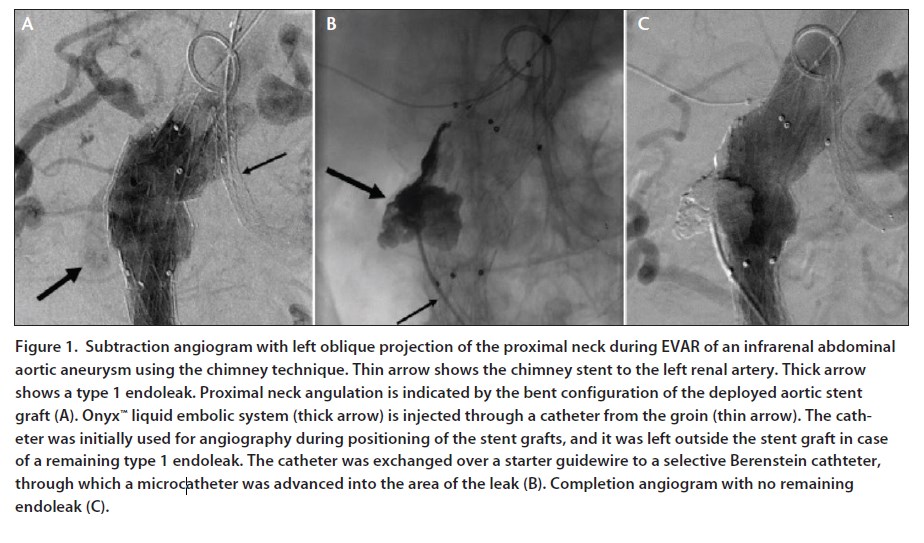
In four cases, a standard angiographic catheter from the groin was left outside the aortic stent graft, crossing the sealing zone. If a type 1 endoleak was found, the angiographic catheter was changed to a selective Berenstein catheter. This was then used as a guide for a microcatheter into the leaking neck. In two cases, selective angiographic catheters and microcatheters were navigated into the proximal neck from a brachial approach after stent graft placement and dilation.
Onyx™ liquid embolic system was injected through a microcatheter (Progreat™, Terumo™, Tokyo, Japan). We used the recommended technique, priming the microcatheter with 0.27 mL DMSO. DMSO is the solvent in Onyx™ liquid embolic system and will prevent Onyx™ liquid embolic system from hardening in the catheter. We then started with just a minimal amount of Onyx™ liquid embolic system injected out of the catheter, letting it begin to harden during a few minutes. A slow injection with several pauses was done, filling the leakage space in the neck. Using this technique, the Onyx™ liquid embolic system usually spreads out in different directions, filling the neck around the stent graft.
Follow-up:
• The type 1 endoleak was successfully sealed by Onyx™ liquid
embolic system in all six patients.
• This was demonstrated by a computed tomography (CT)
scan before discharge or after 1 month.
• There were no perioperative complications and no distal
embolization of Onyx™ liquid embolic system.
• The follow-up time was 3 to 18 months.
• Six patients had no endoleak and decreasing aneurysm
diameter on follow-up CT scan.
Alternative Treatment:
• Balloon-expandable stents.
CONCLUSION
This early experience with Onyx™ liquid embolic system as a bailout solution for treating type 1 endoleak after complicated EVAR is encouraging.
Onyx™ liquid embolic system offers a new treatment option in these difficult situations and may prove to be a good complement to conventional methods, such as stent graft extensions and balloon-expandable stents.
More reported cases and longer follow-up are necessary to evaluate this new technique.
Henrikson O, Roos H, Falkenberg M. Vascular. Vol. 19; No. 2; pp. 77-81, copyright © 2011 by SAGE Publications. Reprinted by Permission of SAGE.
Advertisement
Advertisement