Advertisement
Advertisement
Europe January 2015 Supplement
Sponsored by Covidien
Reduction of CT Beam Hardening Artifacts of Ethylene-Vinyl Alcohol Copolymer by Variation of the Tantalum Content
INTRODUCTION
As Onyx™ was initially approved for embolization of intracranial pathologies, its high tantalum content (TC) ensured fluoroscopic contrast despite the high x-ray absorption of the braincase. Tantalum, however, causes relevant beam hardening artifacts in CT examinations that might limit diagnostic information of any follow-up imaging. We developed an aortic phantom to simulate treatment and follow-up imaging of endoleaks, and assessed the diagnostic performance of Onyx™ liquid embolic system formulations with different, reduced TCs in order to determine a tantalum dosage that interferes less with diagnostic CT imaging, but still enables fluoroscopic visualization during embolization.
METHODS
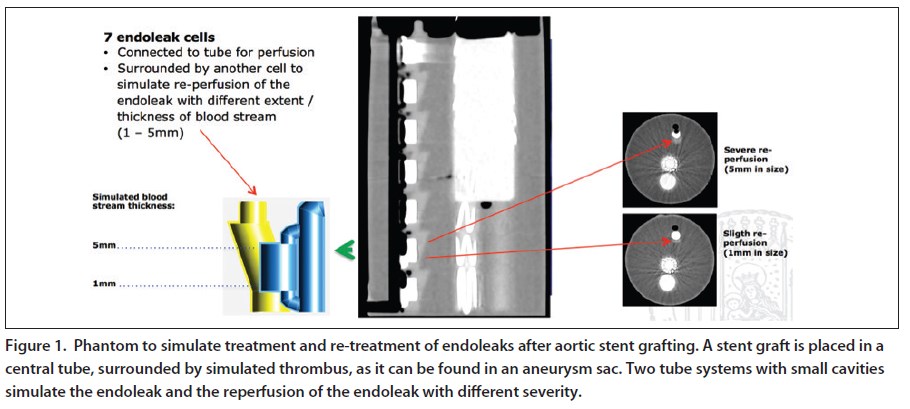
Onyx™ liquid embolic system specimens of different TC (10%-50% and 100%) were injected in an aortic phantom bearing a stent graft and endoleak cavities with simulated reperfusion of different strength (1-mm and 5-mm wide rim of contrast surrounding a simulated endoleak, standing for slight and severe reperfusion) (Figure 1). Fluoroscopic visibility of the Onyx™ liquid embolic system specimens was analyzed. In addition, six radiologists analyzed endoleak visibility and artifact intensity of Onyx™ liquid embolic system in CT scans.
RESULTS
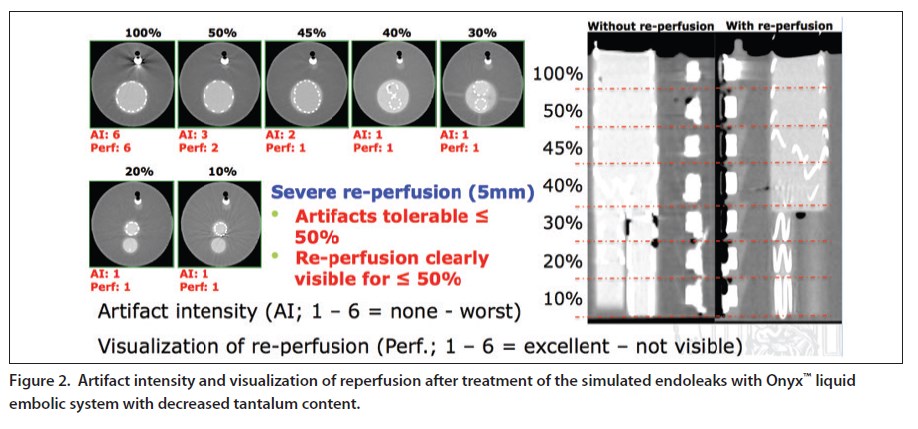
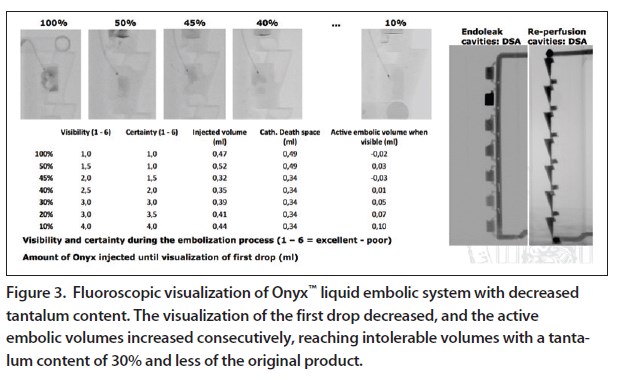
Reduction of TC significantly decreased CT-artifact intensity of Onyx™ liquid embolic system and increased visibility of endoleak reperfusion (P < .000) (Figure 2). It also significantly decreased fluoroscopic visibility of Onyx™ liquid embolic system (R ≥ 0.883; P ≤ .01) and increased the active embolic volumes prior to visualization (Δ ≥ 40 μL) (Figure 3). Onyx™ liquid embolic system specimens with a TC of 45% to 50% exhibited reasonable visibility, a low active embolic volume, and a tolerable CT-artifact intensity.
CONCLUSIONS
Our data suggest a reduction of the TC of Onyx™ liquid embolic system to 45% to 50% of the original to interfere less with diagnostic imaging in follow-up CT examinations, but still allowing for fluoroscopic visualization. This may improve diagnostic accuracy of follow-up CT examinations and provides safe fluoroscopic control of the embolization process.
Presented at the 2012 RSNA annual meeting in Chicago, Illinois.
Advertisement
Advertisement