Advertisement
Advertisement
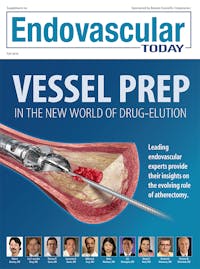
October 2015 Supplement
Sponsored by Boston Scientific Corporation
Expert Panel Discussion on Atherectomy and Vessel Prep: What Roles Do They Play In My Practice?
Endovascular Today sat down with a multidisciplinary panel of esteemed interventionists to discuss their current practice paradigms for atherectomy, including the hot topic of Vessel Prep prior to drug-coated balloons and other adjunctive therapies.
Moderator

Participants





All physicians were compensated for their time associated with this panel discussion and/or article.
EVT: In your practice, have you treated enough patients using the combination of atherectomy and drug-coated balloons (DCBs) (or other adjunctive therapies) to be able to say if your outcomes are better, worse, or about the same compared to treatment with other contemporary therapies such as stenting, specialty balloons, etc.?
Dr. Mustapha: Luckily for us, we use ultrasound 100% in terms of bettering our therapy. One of the things that we’ve done so far [that] we’ve seen a difference with is debulking the target vessel pretty much to the wall, where you can actually go in, prep the vessel, deliver the DCB, and see under ultrasound that the DCB is actually in complete contact with the vessel wall, giving you a 1:1 ratio between the DCB and the vessel wall. I’ve got to tell you, for the first time, we have seen fewer patients coming back with restenosis since DCBs have been out, and atherectomy does make a big difference in those patients if you want to get a proper vessel prep prior to [using a] DCB.
Dr. Shimshak: I think the problem is, like all the trials, [what we see in the] real world is different in terms of the endpoints and the patient population that we deal with day in and day out. I think if we limit the scope of DCBs to short or intermediate-length lesions, there is clear benefit. What I struggle with is making the leap for long superficial femoral artery (SFA) disease—chronic total occlusions that are 20 or 30 cm. That is a huge amount of disease that you’re dealing with. In those patients, I think atherectomy, coupled with whatever other device, gives you optimal luminal gain and is the way to go. That’s why I think vessel preparation is so key. You may be able to achieve [good results in a long lesion] with a DCB, but I think that’s a good place for stenting, and I still believe stenting has a role in those long segments of disease.
Dr. Davis: When we were in the DCB trials, we were treating a very different population of patients’ lesions. Historically, I can say that I know a few patients who have come back when I’ve just used DCBs [to treat them]. I haven’t seen many of the [patients treated with] atherectomy and DCBs, at least in my own sense of it, but we are collecting our data, and I think at the 1-year mark we’ll know a little bit better. I think we need a little bit more time to go by to have a better answer to that question.
I think back over the European data and what Professor Thomas Zeller sees, and you’ve got to take what he says with a lot of stock. He truly is a believer in [atherectomy and DCB], and that’s what he does in his practice.
Dr. Beasley: You see some tremendous results. Early on, I remember a couple of my patients who I treated with atherectomy and DCBs when they first became available. Those patients have not shown any restenosis, reocclusion, or redevelopment of plaque that I can see, and these are patients that I follow closely on external ultrasound in the office.
In my lab, I’m using [multiple DCBs] at a time on a patient and hopefully getting a 70% to 80% success rate, where we don’t have to place a stent. If we do have to place a stent, then you’re placing a bare-metal stent over an area that already has drug on it.
EVT: What is the role of atherectomy in your current practice? Does it depend on the type of adjunctive therapy you are using?
Dr. Beasley: I use atherectomy in almost every case that has anything to do with any type of peripheral vascular disease—any type of critical ischemia or revascularization model. If [the vessel] has plaque, an occlusion, or a stenosis, I use atherectomy to prepare the vessel.
I’m a user of pretty much all the atherectomy devices, so depending on the location of the lesion, the position of the lesion, and the type of the lesion, I’ll use a particular atherectomy device. I know with DCBs, you want to debulk and expose the vessel wall to that drug. With stenting, you want to give the stents a chance so that the stent’s drug can appose itself to the wall the best possible way it can. So, I pretty much use atherectomy at all times.
Dr. Noor: I started using atherectomy early in my fellowship training so I took to it really easily—it wasn’t as difficult to learn when you have already adopted other techniques, and at that time, it was really just angioplasty and stenting. I really like the philosophy of atherectomy, which has luminal gain and removal of the plaque, allowing the vessel to be more compliant with minimal trauma. Everything else that we do to the vessel in order to get luminal gain causes more injury and trauma and sets you back a year from now, when you have disease recurrence.
I use atherectomy, depending on the lesion, almost everywhere. In the femoral, popliteal, or below-the-knee distribution, atherectomy is probably my first line of defense. It then allows you to decide how you want to treat after. I’m not a big stenter; however, I will use focal stenting, depending on how much lesion or disease is left behind. I think it’s a great platform for DCBs and possibly drug-eluting stents (DESs) once we have a little bit more data.
Dr. Mustapha: I try to marry each atherectomy device with the type of lesion or plaque that I’m facing at the time. In our institution, we use extravascular ultrasound, and that has been extremely helpful. We evaluate the plaque that we’re dealing with and actually make a decision on which type of atherectomy device we’re going to use based on what we saw. [Under fluoroscopy,] we tend to undersize the vessel significantly, especially in the SFA/popliteal and tibial vessels. Based on what we see on ultrasound, we are able to debulk or modify the vessel [plaque] more accurately.
Dr. Shimshak: For me, it really comes down to plaque burden. When you begin to look at these vessels from a physical standpoint, you begin to realize why balloon angioplasty has failed at the most basic level. Remember, you cannot achieve an adequate lumen just by compressing that material. By the same token, even if you are an aggressive stenter, you [may] not be able to achieve optimal luminal dimensions of the stent even with the highest-performing stents today without preparing that vessel, in my opinion. I think balloon angioplasty is not enough. As Dr. Noor said, there is no question that as we begin to embark on preparing the vessel with balloon angioplasty when these vessels are highly calcified, there’s a high incidence of dissections that are generated, which impacts patency and the durability of whatever intervention you perform.
Dr. Davis: To add onto that complexity, as years go on, we all push the envelope in terms of the types of vessels we’re willing to treat. As the complexity of lesions increases, I think atherectomy really is almost imperative in those types of lesions—long calcified lesions, thrombotic, and mixed lesions. As we push the limit, that’s where we need it more.
Dr. Mustapha: Intimal calcification is different than medial calcification. Intimal calcification is the one that actually causes the problem for us, in particular if you deploy a stent without prepping the vessel properly—this is where you see the stent kinked. Intimal calcification has a significantly higher density of calcium deposit in it versus medial calcification. This is where the term “debulking” versus modifying the plaque comes into play. Knowing what kind of lesion you’re dealing with is extremely important. Sometimes you may not be able to debulk it, so you modify it, and you will be able to dilate it.
Dr. Shimshak: To Dr. Mustapha’s point, 360° calcification cannot be approached with angioplasty or any other device short of debulking. In my practice, the other traditional subset, as Dr. Davis alluded to, that we backed off from and now are pushing the envelope on, would be common femoral disease. I don’t think every [case of] common femoral disease needs to be treated with endarterectomy. I think there are subsets that can be treated with endovascular techniques, and I think intravascular ultrasound (IVUS) is the guide for that, correlated with angiograms.
EVT: Despite a lack of level 1 data, what inspires your confidence in using atherectomy prior to DCB? What would you say to peers of yours who have not yet incorporated vessel prep with atherectomy into their practice, prior to using DCB in certain lesion types?
Dr. Noor: It’s unfortunate that atherectomy doesn’t have good level 1 evidence. It’s probably a failure on all of our parts that there isn’t good level 1 evidence that allows you to compare such a good modality of treatment with other standard modalities out there. But if I had to do every case with level 1 evidence, I would only get half my cases done, realistically.
It does take time. The problem with atherectomy is that there is a learning curve, and it’s a steep learning curve. There are multiple devices out now, so it’s difficult to be able to learn each one of them, but if you would pick one or two, you could use it. It’s not as easy and fast as angioplasty and stenting—it’s a labor of love—but I think you offer your patients a very good solution.
Dr. Beasley: When you take a look at IVUS and see the concentric luminal gain after atherectomy, and you take the Fanelli results into account, and then the dispersion of the balloon and paclitaxel into the wall, when you improve the wall apposition—it’s an argument you make without level 1 evidence, but it’s an argument that I think that most reasonable folks can understand.
Dr. Shimshak: I think it’s a leap at this point; we don’t have the robust datasets that we want. I think it will come, but the message I would convey to people who are not yet embracing atherectomy, to help them understand the power of that therapy, would be to begin to use IVUS if they’re not using IVUS. I think that is the key element in understanding the utility of this approach. Then, be guided by atherectomy coupled with other new technologies that do have more proven efficacy.
Dr. Mustapha: Stents did not always have level 1 evidence. Eventually, atherectomy will have level 1 evidence, and operators who don’t use atherectomy today will hopefully see the value of atherectomy then. We had an atherectomy study [DEFINITIVE LE, Medtronic] that had a patency rate similar to stenting, so you already have something that tells you atherectomy is as effective as stenting in certain situations.
Many operators are reluctant to make the shift toward atherectomy utilization. In part, it could be due to the ease of use of a stent and/or not wanting to invest the time using atherectomy. In my opinion, atherectomy is the first tool to think of when trying to achieve the most effective vessel prep.
Dr. Davis: I go back to my Stone Age days when I was just using balloon angioplasty in the coronary [arteries], and then stents came out, and we always [thought] we shouldn’t stent all the time, we should do bailout stenting. [Then] all of a sudden, stenting became this phenomenal thing. Then DESs came out, but because of the cost, you only used them in certain areas and at certain times. Now, if you don’t put a DES in there, you’re committing malpractice unless there’s a good reason not to. So I think part of this is cost—costs have come down, and I think we’ve gotten used to the outcomes there.
I think drug delivery is here to stay, and right now, we have DCBs as our delivery system. Who knows where the technology is going to go and what’s going to be the best delivery system, but that’s what our system is.
EVT: How are you currently making the decision on which atherectomy device to use for vessel prep prior to using a DCB?
Dr. Shimshak: Calcium is critical to remove and prepare the vessel, but I also think it’s plaque burden. Whatever device offers you the ability to debulk varying morphologies is my go-to device. There aren’t very many that fit that bill. Most of the atherectomy devices are better for some things than others, but in my clinical practice, the JETSTREAM™ Atherectomy System (Boston Scientific Corporation) gives you predictability for varying lesion morphologies. Even for the non-IVUS users, I think there’s comfort in that, if you don’t understand the extent of disease, the device will perform admirably regardless of what kind of morphology you’ve encountered—soft plaque, eccentric, concentric, varying degrees of calcium, thrombus—it provides functionality for all those lesion morphologies.
In my practice, I would say over 90% [of the time, the] atherectomy device that I select off the shelf is JETSTREAM, for the reasons that I’ve already discussed. It gives me high performance for varying lesion morphologies, it’s predictable, and it has a safety profile that’s desirable. The aspiration is key, and I find it to be very desirable regardless of where I am.
Dr. Noor: Any time you performed a peripheral vascular intervention and you’re concerned about thrombus, it’s almost a contraindication to do anything because before, if you embolized the thrombus, we didn’t have a lot of options. We had to lyse it and then you had to go back in and treat the underlying lesion.
But with newer technology, you can still go in and lyse it or use the AngioJet™ Thrombectomy System (Boston Scientific Corporation) and then treat it with atherectomy, or use JETSTREAM, which allows you to do both [atherectomy and thrombectomy, due to JETSTREAM having an indication for both]. The concept of being able to treat the thrombus and the underlying disease at the same time is very attractive not only for the patient and the time spent in the lab, but also from a cost standpoint. There are a lot of advantages to doing that, and your complication rate hopefully is lower with or without a filter, depending on how comfortable you are using one or not.
Dr. Davis: There is a lot more thrombotic disease that we just don’t recognize in these lesions. Dr. Shimshak, as you’ve noticed, too, that’s why by IVUS, with the virtual histology, you see it. When you do an OCT, the thrombotic areas are much more evident. A surgeon would probably recognize it more than we would, but as interventionists, you don’t really recognize exactly how much thrombus you’re dealing with on occlusive disease in the SFA.
Dr. Beasley: For the great majority of the SFA, [I use] rotational atherectomy because you have the benefit of not only being able to get a really nice channel, but also a very concentric luminal gain that you can then use for your adjunctive treatment modality, be it DCBs or stenting. You also have that aspirational component where you can at least be sure of yourself that you’re pushing through and debulking this plaque.
ATHERECTOMY AND DCBs: A Q+A WITH DR. NICOLAS W. SHAMMAS

Nicolas W. Shammas, MD, MS, FACC, FSCAI
President and Research Director, Midwest Cardiovascular Research Foundation; Adjunct Clinical Associate Professor, University of Iowa; and Consultant and Interventional Cardiologist, Cardiovascular Medicine, PC
Davenport, Iowa
He has disclosed that he received related research and educational grants for the Midwest Cardiovascular Research Foundation from Boston Scientific Corporation, Medtronic, and CSI; and is a trainer for the JETSTREAM Atherectomy System, is on the speakers’ bureau for Boston Scientific Corporation, and is a member of the JET steering committee.
Dr. Shammas may be reached at shammas@mchsi.com.
EVT: In your practice, in which lesion types are you choosing to perform vessel prep with atherectomy prior to DCBs?
EVT: Do you think thrombus is underappreciated in peripheral artery lesions? How important is clearing the thrombus barrier prior to utilizing DCBs?
EVT: How important is creating concentric lumens or circumferential lumens with atherectomy in order to create a uniform landing zone for DCB?
EVT: What type of clinical data would you like to see in the future regarding atherectomy and DCB?
1. Tarricone A, Ali Z, Rajamanickam A, et al. Histopathologicial evidence of adventitial or medial injury is a strong predictor of restenosis during directional atherectomy for peripheral artery disease. J Endovasc Ther. 2015;22:712-715.
Advertisement
Advertisement