Advertisement
Advertisement
January 2021
Tips and Tricks for Treating Aortic Injuries in the Hybrid Suite
Strategies for success with endovascular management of blunt aortic injury.
Our specialty’s dedication to learning new skills while also maintaining our ability to manage complex open surgical management of acute vascular care has made us a critical component to the level 1 trauma center. With the rise of the acute care surgery model, there has been an unspoken shifting of care for vascular traumatic injuries to the vascular surgery service. Our ability to quickly control hemorrhage—through either endovascular or open means—combined with the concomitant decline in general surgery residency exposure to vascular care, has made the hybrid suite an ideal place for traumatic injuries to be adjudicated in a modern hospital system.
Dr. Benjamin Starnes, an endovascular leader and former United States Army surgeon, articulated the concept of vascular trauma much more eloquently in his 2020 address to the Southern California Vascular Surgery Society.1 The ability to control hemorrhage without cavity operations, decrease blood loss, decrease anesthetic time, avoid exposure of tamponade, and work expeditiously to obtain percutaneous access has revolutionized the modern traumatic approach. No aspect of vascular trauma surgery has benefited more from endovascular techniques than blunt aortic injury (BAI).
CASE EXAMPLE
Presentation
The vascular team was already in the hospital repairing an infected axillary anastomosis from a previous problematic upper extremity bypass when the trauma service came to the room and reported an unstable patient in their 20s who presented as a level 1 trauma alert for a high-speed motor vehicle collision. The patient was unstable en route and was intubated for mental status changes. After the appropriate primary survey and establishment of intravenous access, the patient was taken for emergent CT. Figure 1 shows what was shown on-screen in the operating room.2 CT demonstrated concomitant grade 3 liver laceration and multiple orthopedic injuries. Head CT was negative for intracerebral injury. Per the trauma chief’s report, the patient was hemodynamically labile and required ongoing fluid bolus, and massive transfusion protocol was initiated.
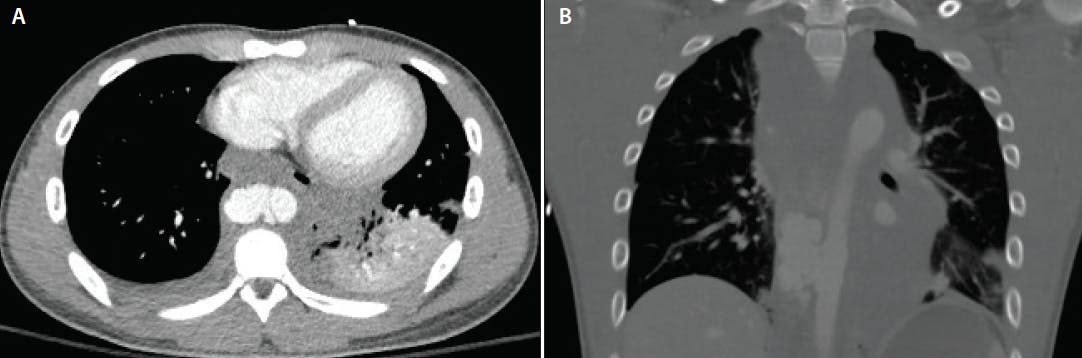
Figure 1. Axial CTA at presentation demonstrating grade IV BAI as described by Lamarche et al2 (A). Coronal image of the same CTA, with active extravasation into the mediastinum, poorly defined pseudoaneurysm, and large intimal defect (B).
Intervention
The patient was brought to the hybrid operating room by the trauma team. The vascular surgery team percutaneously obtained access to the right common femoral artery using ultrasound guidance. A 9-F sheath was placed, and it was decided that systemic heparin not be given due to concern for ongoing hemorrhage. A 0.035-inch Glidewire Advantage (Terumo Interventional Systems) was advanced under fluoroscopy into the ascending aorta, an 8.2 Visions PV intravascular ultrasound (IVUS) catheter (Philips) was advanced, and the level of injury was confirmed.
IVUS demonstrated an intimal defect across an approximate 6-cm length of the mid-descending thoracic aorta. Using the IVUS catheter, proximal and distal seal zones of 3 cm on either side of the injury were delineated, and the diameter in the areas of seal were confirmed in systole to be 16 and 15 mm, respectively. In rapid progression, the IVUS was advanced into the ascending aorta both to confirm no retrograde injury and allow for protected exchange for a 0.035-inch
curved Lunderquist wire (Cook Medical). The 9-F sheath was exchanged for a 20-F Gore DrySeal sheath (Gore & Associates), which was flushed with heparinized saline.
Then, a 21-mm X 21-mm X 10-cm Conformable Gore TAG (cTAG) thoracic endoprosthesis (Gore & Associates) was advanced to the desired zone, and a pigtail catheter was advanced into the aortic arch with the buddy wire technique. Angiography using a single injection of 30-mL iodixanol confirmed landing distal to the curve in the proximal descending thoracic aorta (Figure 2A), and the device was deployed. A second piece was brought in and deployed, with an additional 2 cm of overlap to minimize complete aortic coverage at a total of 12 cm but still achieve an adequate seal. No ballooning was performed, and completion angiography demonstrated no further extravasation into the mediastinum (Figure 2B). IVUS was readvanced, confirming the full expansion of the cTAG devices; the catheters and wires were removed under fluoroscopic guidance. Because of the patient’s instability on arrival to the hybrid suite, we elected to forego preclosure of the arteriotomy. Thus, cutdown was performed at the conclusion of the case, and full control of the femoral artery was obtained above and below the cannulation site. The artery was vigorously flushed from each direction after cannula removal, and interrupted artery closure was performed. The patient was hemodynamically stable when transferred to the trauma intensive care unit, with no further vasoactive medication or fluid bolus requirements.
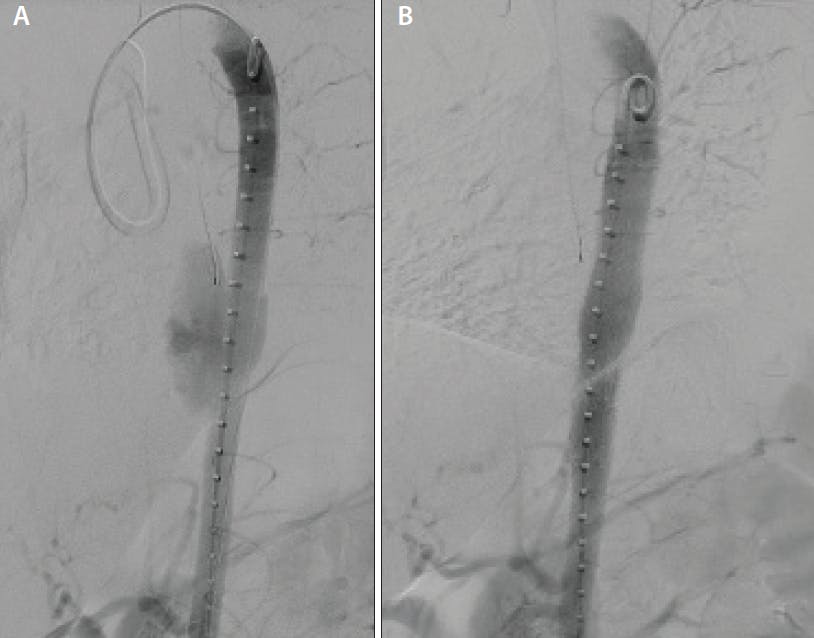
Figure 2. Control angiogram demonstrating landing zones in the straight portion of the aorta and well above the celiac artery, as well as multiple intercostal vessels (A). Completion angiogram demonstrating no extravasation and preservation of multiple intercostal arteries above and below the repair (B).
Follow-up chest CTA before discharge and at 6 months postprocedure demonstrated no complications (Figure 3). The patient had normal bowel, bladder, and lower extremity function at time of last follow-up.
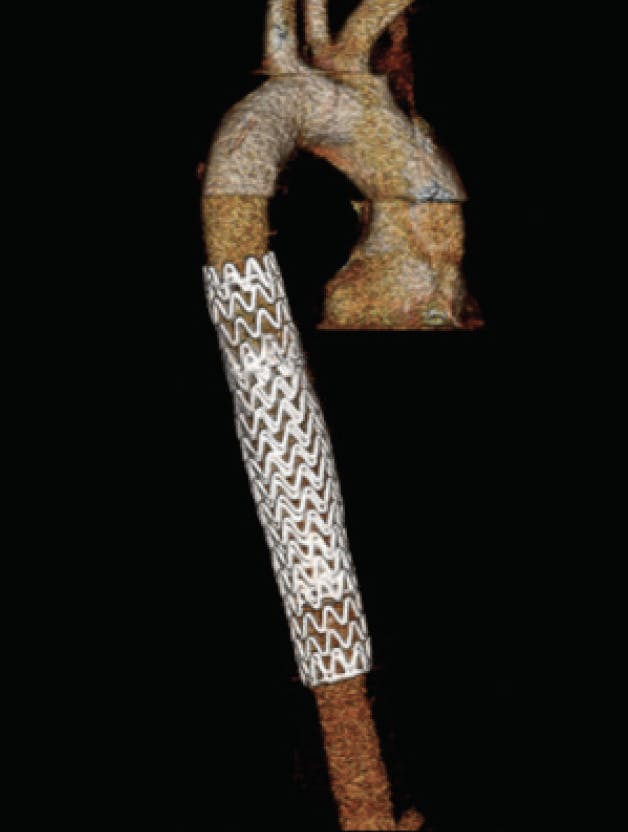
Figure 3. The 6-month postoperative CTA reconstruction.
DISCUSSION: TIPS AND TRICKS
No trauma diagnosis has benefitted more from endovascular therapy than BAI. A landmark prospective trial reported by the American Association for the Surgery of Trauma on the outcome of patients treated acutely for BAI with thoracic endovascular aortic repair (TEVAR) versus open aortic repair showed definitive superiority in overall mortality (7.2% vs 23.5%; P = .001) and adjusted mortality (adjusted odds ratio, 8.42; 95% CI, 2.76-25.69; P < .001), with a trend toward improved neurologic outcome.3 These outcomes were achieved with early experience endografts that have now been improved to limit postoperative complications in the unique milieu of the injured aorta. Our understanding of operative planning, maturation in device designs, and the presence of hybrid operating rooms with shelf stock of a wide range of sizes and the capacity to handle complex cases and the potential need to convert to emergency laparotomy, thoracotomy, or even orthopedic procedures has made TEVAR the standard of care in the management of BAI today.
Tip 1: Graft Sizing
I use this case to highlight some finer points of TEVAR for BAI, especially when time is of the essence. First and foremost, the graft in these cases should be sized as close to a 1:1 ratio as possible to prevent excessive radial force on the injured aorta. Modern engineering of thoracic stents has greatly reduced the potential for stent collapse or “bird-beaking,” but the long-term effect of self-expanding stents in the aorta is still not determined, especially in very young patients. To limit the potential for retrograde aortic dissection, I do not recommend balloon dilation after deployment.
Tip 2: Landing Zone
Regarding landing zones, controversy exists. A recent report by Yoon and Mell brought concern for shorter landing zones, which led to increased rates of type I endoleak and overall complication rates even in traumatic injuries.4 However, I have found that in BAI, as a general rule, the stent provides a scaffold to allow for aortic healing and prevent acute hemorrhage. Compared to an aneurysm case, the length of normal aorta at either end of the stent can be shorter than the instructions for use for aneurysm; but if type I endoleak is present, an extension can be performed proximally over the left subclavian and the patient can be assessed for revascularization need after other injuries are stabilized. In a case, such as described previously, when hemorrhage control is the absolute necessity of the case and not just exclusion of a pseudoaneurysm, I plan to obtain at least 2 cm of seal on either side of the intimal defect.
Tip 3: Device and Imaging Selection
Regarding graft choice, I stress to my trainees that when the situation is rapidly evolving, use the device with which you are most comfortable. We have always maintained a full line of Gore cTAG devices, and as such, that has been our standard graft for BAI needing acute treatment. I described previously the one-sheath technique that minimizes the overall steps for TEVAR. Certainly, a separate groin puncture for angiographic control is reasonable for operators who are facile with other devices, but one could argue that these cases can be performed solely with IVUS. This highlights the other critical step in the treatment of BAI: using the IVUS catheter. I find IVUS to be significantly more sensitive than standard angiography alone at delineating the zones of healthy aorta and identifying the extent of injury. Further, IVUS images captured in systole provide real-time sizing of TEVAR landing zones that may have been undersized during the initial CT scan due to hypovolemia.5
Tip 4: Bleeding Risks
In addition, the presence of intracranial injury, solid organ injury, or other concern for bleeding should not preclude the performance of TEVAR for BAI if needed urgently. In cases when heparin is not deemed safe, frequent flushing of the sheath followed by open exposure and vigorous flushing of the iliac and femoral vessels can prevent limb thrombosis. In these cases, I prefer to perform the exposure before access if the patient is stable; however, it can certainly be performed after TEVAR when the clinical scenario dictates that each second counts. Further, prompt TEVAR will allow blood pressure parameters to be liberated and aid in the maintenance of cerebral perfusion pressure, which can be critical in a patient with multiple injuries.
Tip 5: Neurologic Considerations
Finally, any case of thoracic aorta manipulation must consider possible neurologic complications. In a retrospective, multicenter analysis of the management of BAI, Dubose et al found only one case (0.5%) of paralysis in a patient treated with TEVAR for a BAI that required 20 cm of coverage.6 In addition, two (1%) patients experienced a stroke, and both were > 60 years of age. As a rule, I try to limit the extent of aortic coverage to the least possible in these cases because of possible postoperative hypotension from other associated injuries. I am especially cautious about coverage of the left subclavian unless necessary, as well as coverage of the distal 4 to 5 cm of supraceliac aorta in the area of the artery of Adamkiewicz.7 In the case example, two components were used to minimize the overall coverage zone while still ensuring adequate seal on either side of the life-threatening injury. I try to limit wire manipulation in the ascending aorta and use the IVUS catheter for wire exchange to decrease the likelihood of embolization.
CONCLUSION
The ability to stabilize and definitively repair BAI while minimizing further blood loss, stroke, and spinal cord injury has pushed vascular surgery to the forefront of thoracic aortic trauma management. As much as endovascular aneurysm repair has been the foundation for expanding endovascular skills into multiple vascular beds and pathologies in modern vascular practice, so too has TEVAR for BAI demonstrated that endovascular therapy can succeed in treating difficult-to-expose and high-risk anatomic beds with minimal morbidity and mortality.
1. Starnes B. Alea Iacta Est. Presented virtually at: Southern California Vascular Surgery Society 38th annual meeting; October 24-25, 2020. https://www.youtube.com/watch?v=jZvzygDi6Rc
2. Lamarche Y, Berger FH, Nicolaou S, et al. Vancouver simplified grading system with computed tomographic angiography for blunt aortic injury. J Thorac Cardiovasc Surg. 2012;144:347-354. doi: 10.1016/j.jtcvs.2011.10.011
3. Demetriades D, Velmahos GC, Scalea TM, et al; American Association for the Surgery of Trauma Thoracic Aortic Injury Study Group. Operative repair or endovascular stent graft in blunt traumatic thoracic aortic injuries: results of an American Association for the Surgery of Trauma multicenter study. J Trauma. 2008;64:561-570; discussion 570-571. doi: 10.1097/TA.0b013e3181641bb3
4. Yoon WJ, Mell MW. Outcome comparison of thoracic endovascular aortic repair performed outside versus inside proximal landing zone length recommendation. J Vasc Surg. 2020;72:1883-1890. doi: 10.1016/j.jvs.2020.03.033
5. Pearce BJ, Jordan WD Jr. Using IVUS during EVAR and TEVAR: improving patient outcomes. Semin Vasc Surg. 2009;22:172-180. doi: 10.1053/j.semvascsurg.2009.07.009
6. DuBose JJ, Leake SS, Brenner M, et al; Aortic Trauma Foundation. Contemporary management and outcomes of blunt thoracic aortic injury: a multicenter retrospective study [published erratum appears in J Trauma Acute Care Surg. 2015;78:656]. J Trauma Acute Care Surg. 2015;78:360-369. doi: 10.1097/TA.0000000000000521
7. Taterra D, Skinningsrud B, Pękala PA, et al. Artery of Adamkiewicz: a meta-analysis of anatomical characteristics. Neuroradiology. 2019;61:869-880. doi: 10.1007/s00234-019-02207-y
Advertisement
Advertisement