Advertisement
Advertisement
May 2021 Supplement
Sponsored by Philips
Case Report: Enhanced Tack Placement Using IVUS in Severe Stenosis of the Proximal Anterior Tibial Artery
CASE PRESENTATION
A man in his late 50s with prior lower extremity revascularization for femoropopliteal disease presented with a several-month history of a nonhealing lateral left foot wound after referral from his podiatrist. The patient’s cardiovascular risks included insulin-dependent diabetes mellitus, hypertension, dyslipidemia, and a history of coronary artery disease with cardiac stenting 8 years ago. He denied cerebrovascular disease or renal dysfunction. Neuropathy in his lower extremities was reported. The patient’s medications included clopidogrel, hydrochlorothiazide 12.5 mg, lisinopril, amlodipine, carvedilol, insulin glargine, metformin, and aspirin.
PROCEDURAL OVERVIEW
Initial angiography showed stenosis in the proximal anterior tibial artery, which was confirmed on distal angiography to be the wound supply and was therefore the target lesion for treatment (Figure 1). The posterior tibial artery had significant disease in the mid portion and a distal occlusion that was not directed toward the patient’s wound.
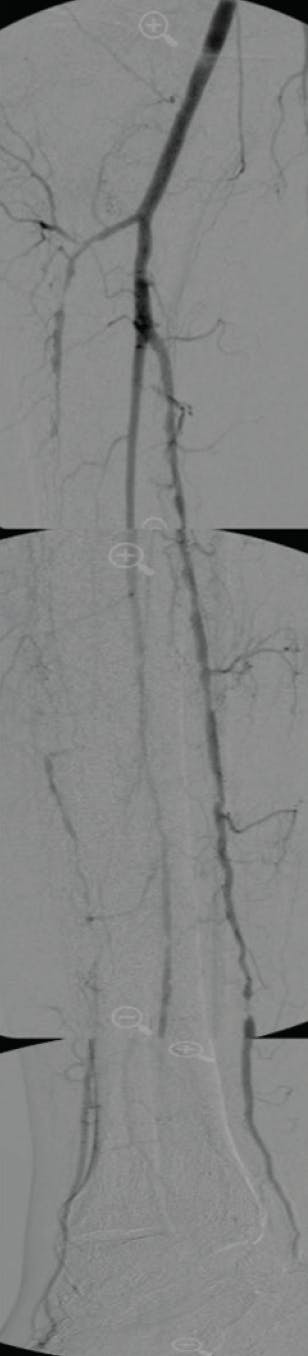
Figure 1. Initial angiogram showing the proximal anterior tibial artery with multiple stenoses. The anterior tibial artery is the dominant wound supply.
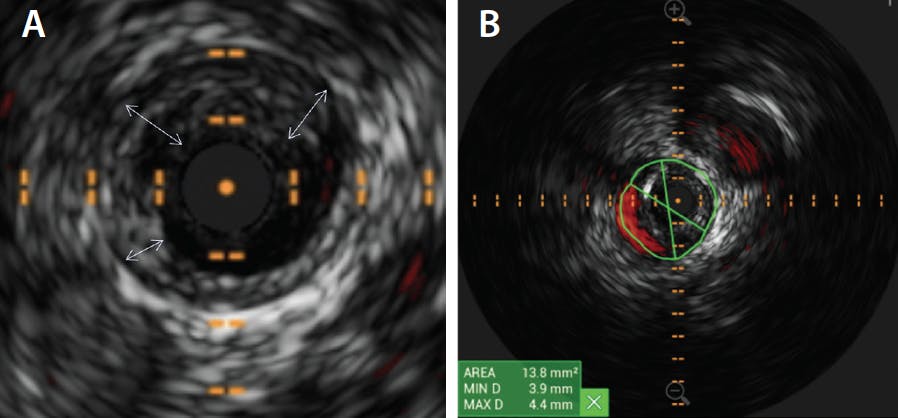
Intravascular ultrasound (IVUS) of the proximal anterior tibial artery showed substantial plaque burden with severe stenosis (Figure 2A, double-headed arrows) and allowed for “true” sizing. Based upon IVUS arterial sizing, percutaneous transluminal angioplasty (PTA) with a 4-mm X 24-cm balloon was performed (Figure 2B).
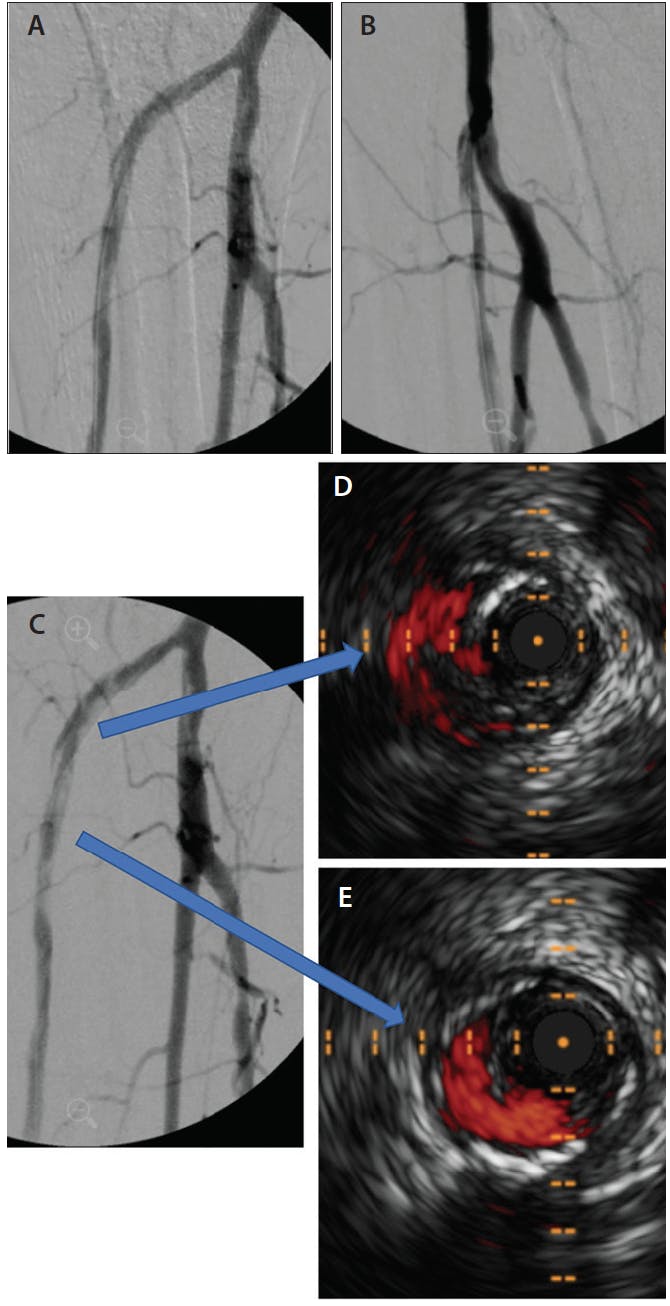
After PTA, patency was restored, but significant proximal dissection was confirmed in two oblique angiographic projections and with IVUS (Figure 3A-3E). Note the depth of the dissection extending to the adventitia in Figure 3D.
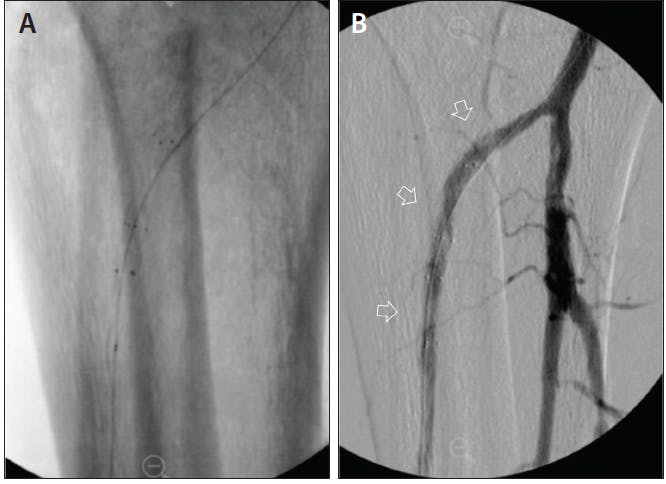
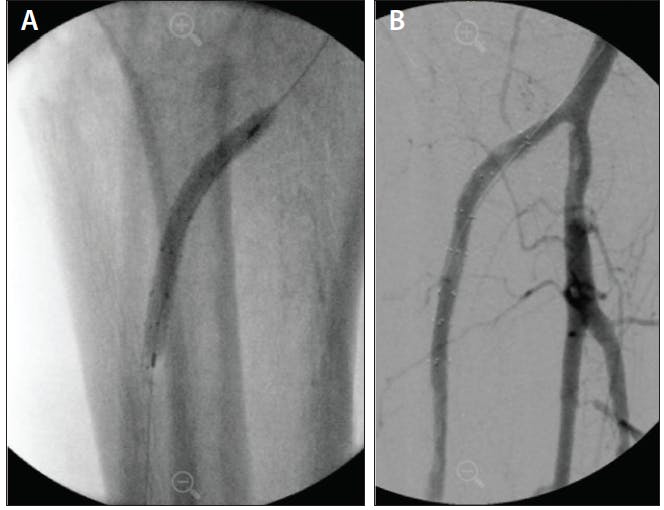
A total of four Tack implants (Philips) were deployed, with one each at the beginning and end of the dissection as identified on IVUS and two in the mid portion of the dissection (Figure 4). Angiography after Tack placement but prior to postdilation showed a smoother lumen and good Tack positioning. However, there were focal areas of residual luminal compromise due to dissection that were not completely covered with the initial Tack deployment (Figure 4B, arrowheads).
Three additional Tacks were strategically deployed at areas of residual arterial narrowing, and postdilation was performed with a new 4-mm X 4-cm balloon for 30 seconds. Completion angiography showed complete dissection resolution and restored arterial patency without residual stenosis or recoil (Figure 5).
Advertisement
Advertisement