Advertisement
Advertisement
May 2021 Supplement
Sponsored by Philips
The Four Pillars of IVUS for the Endovascular Treatment of CLI
Understanding the role of intravascular ultrasound in the treatment of critical limb ischemia.
Critical limb ischemia (CLI) can be considered the end stage of atherosclerotic plaque progression along the lower limb arteries. Every year, nearly 2% of patients with peripheral artery disease (PAD) progress to CLI.1,2 CLI is a major, potentially life-threatening condition, associated with a high risk of minor and major limb amputations, resulting in a significant increase in mortality.3 Aside from the risk of major adverse cardiovascular and limb events, CLI management is associated with high health care costs.3
Revascularization by surgical bypass or endovascular intervention (EVI) is considered the cornerstone of CLI management to attempt limb salvage and prolong life.4 Diagnostic peripheral angiography with fluoroscopy and digital subtraction angiography (DSA) is considered the gold standard for visualization of lower limb vasculature. Nevertheless, this imaging modality has its limitations in identifying of plaque morphology and geometry. Even when applying biplanar angiography, the actual dimension, depth, and anatomic characteristics of the plaque elude this imaging technique.
EVI of CLI is challenging due to the multilevel involvement and high frequency of chronic total occlusions (CTOs).4 Furthermore, patients with CLI have comorbidities such as older age and chronic kidney disease and are thereby at high risk for EVI complications.5 Because of these challenges in the interventional management of CLI, we recommend the use of intravascular ultrasound (IVUS) as an imaging tool to facilitate and improve the understanding of the atherosclerotic burden and vessel dimensions, thereby allowing for accurate device selection for EVI. Despite available evidence for improving procedural success and clinical outcomes of patients undergoing IVUS-guided coronary intervention,6 similar studies in EVI are limited. Nevertheless, several retrospective studies have shown improved patency and reduction of reinterventions with the use of IVUS for EVI.7-9 However, those studies were mostly performed as retrospective observational studies with no suitable comparator. Furthermore, in an analysis from the Nationwide Inpatient Sample (NIS) database, the use of IVUS was associated with nonsignificantly higher hospital costs but a significantly lower rate of postprocedural complications.10
Recently, four pillars of IVUS in PAD have been presented: visualizing plaque geometry, defining plaque morphology, vessel sizing, and guidewire orientation.11 This article will highlight the importance of each pillar in the endovascular revascularization approach to CLI management. Furthermore, we want to discuss the importance of the confirmation of the four pillars.
THE Four PILLARS OF IVUS IN PAD
Visualizing Plaque Geometry
IVUS is superior to DSA in differentiating between eccentric and concentric plaque (Figure 1). Knowledge of plaque geometry may facilitate the selection of interventional devices, especially when performing atherectomy. Furthermore, orienting a directional atherectomy device toward the nonaffected side may eventually result in an adventitial cut and cause a higher degree of vessel trauma, affecting patency rate.12 On the other side, identification of circumferential concentric plaque implies the need for pretreatment of the vessel with plaque modification devices to achieve optimal results.
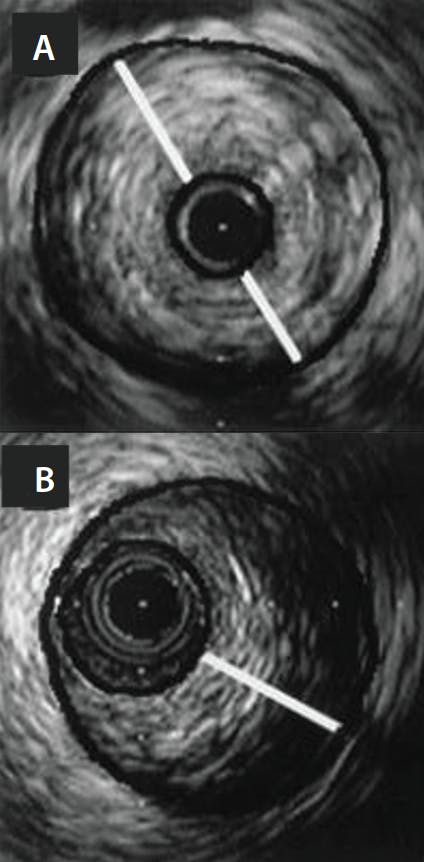
Figure 1. IVUS image of plaque geometry. Panel A represents a concentric plaque. Plaque burden is equal in thickness/volume 360° around the vessel. Panel B represents plaque burden that is higher on one side of the vessel and often includes an area of healthy vessel.
Plaque Morphology
The use of IVUS permits the examiner to distinguish between four subtypes of atherosclerotic plaque clearly. Atherosclerotic plaque can be divided according to fat and fibrous tissue content into fatty and fibro-fatty, fibrous, and calcified plaques (Figure 2). Softer plaques like fatty and fibro-fatty plaques are more easily dilated with plain balloon angioplasty (PTA) while bearing the risk of embolization on the other side. In such a lesion subset, an additional identification of the plaque’s longitudinal extent improves the positioning of a scaffold to cover the entire affected segment. Fibrous and calcified plaques are more challenging to treat. Ex vivo IVUS analysis of amputated limbs confirmed that tibial arteries have a higher degree of fibrous and calcified plaque than popliteal arteries.13 Early recoil has been described as one of the significant limitations of treating calcified tibial arteries.14 Furthermore, IVUS allows identification of the depth and circumference of the calcium arch. Knowledge of these plaque qualities helps the examiner adequately select plaque modification tools such as orbital atherectomy or, more recently introduced, intravascular lithotripsy. Plaque modification permits a less aggressive PTA, thereby reducing the risk of barotrauma and dissection of the vessel with subsequent need for utilization of a vascular scaffold.
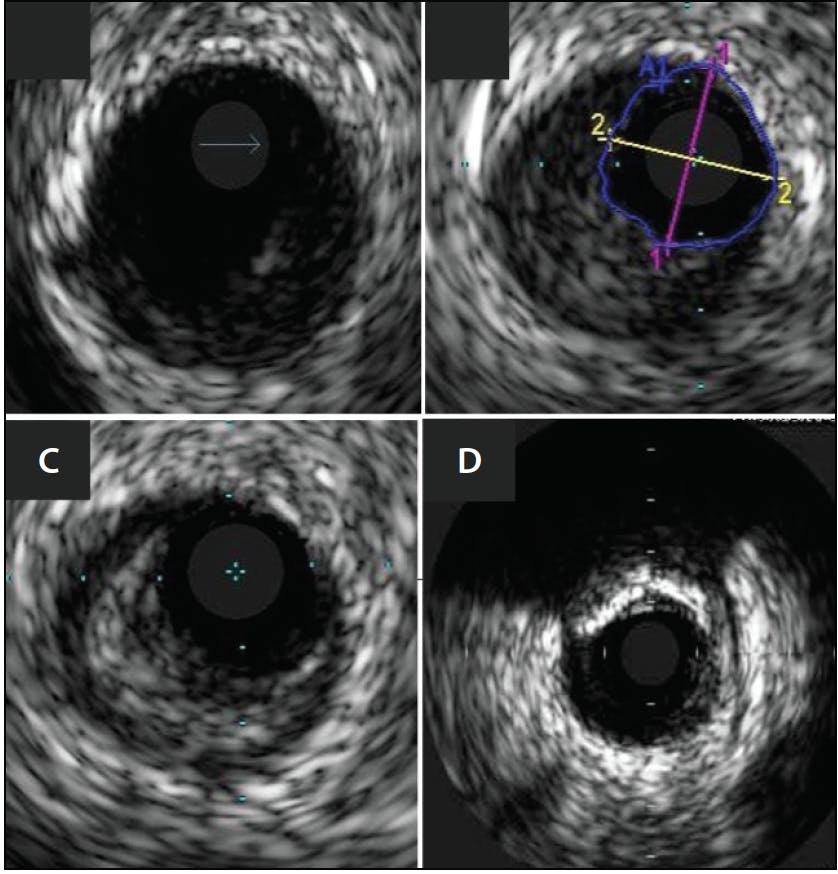
Figure 2. IVUS image of plaque morphology. Panel A represents a fatty plaque, which is the darkest gray (more echolucent) very compliant, gelatinous, and prone to shift. Panel B represents fibro-fatty plaque, which is dark gray, more structured than a fatty plaque but still compliant, and will shift with force. Panel C represents a fibrous plaque, which is the lightest gray (more echogenic) and tight network of plaque that is less likely to shift and therefore more likely to be noncompliant, especially in concentric lesions. Panel D represents a calcified plaque; calcium is highly echogenic, appearing bright white on IVUS with an acoustic shadow behind it.
Vessel Sizing
Vessel sizing is paramount to select appropriate interventional devices (Figure 3). Lumen and vessel areas can be measured, and percent area stenosis and plaque burden can be calculated. Plaque burden has been associated with a high risk of subsequent events.15 Furthermore, DSA, especially in the tibial arteries, does not permit the examiner to estimate vessel size. This limitation is frequently associated with either over- or undersizing balloons for PTA, resulting in either increased barotrauma and vessel injury or residual stenosis. Both conditions have been associated with a reduction of patency.16
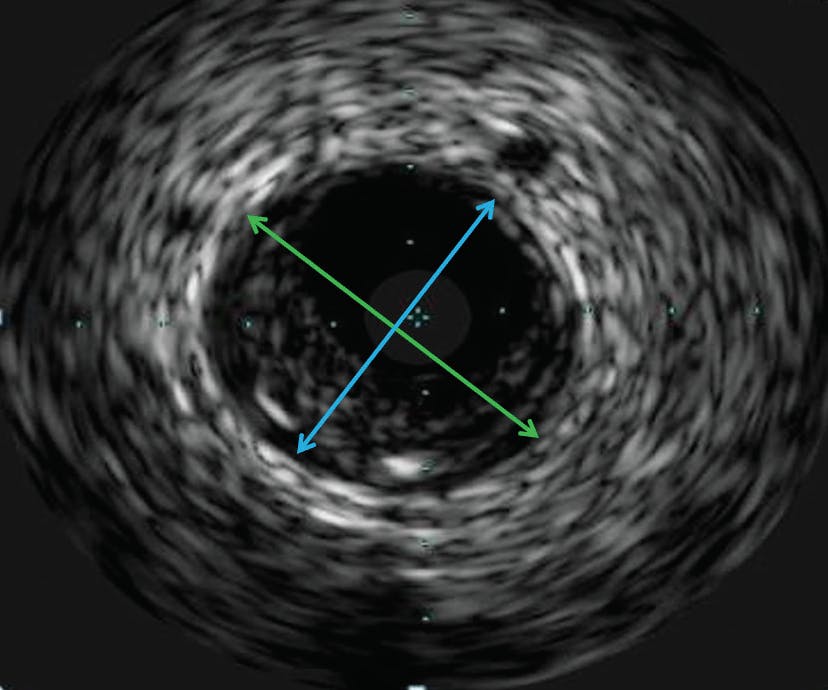
Figure 3. IVUS image with measurement of vessel dimensions. The green arrow indicates maximum and the blue arrow indicates minimum vessel diameter.
Guidewire Orientation
EVIs for CLI are frequently performed in CTOs. In many cases, a subintimal crossing of a CTO lesion with reentry into the true lumen might occur. Using IVUS after wire passage, the examiner will quickly recognize the wire orientation and be able to make a suitable device selection (Figure 4). For instance, using an atherectomy device in such a lesion may cause substantial media or adventitia injury, which might affect the intervention site’s patency.12 On the other side, an intraluminal crossing of a CTO lesion has a tremendous plaque burden and may need methodic plaque modification before PTA or stenting.
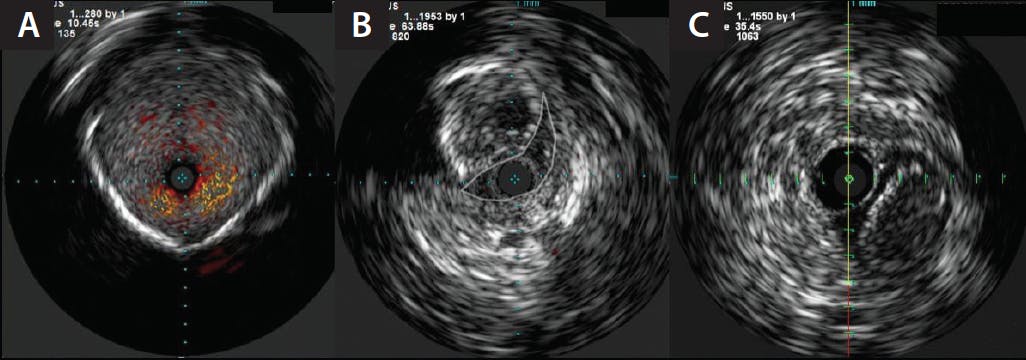
Figure 4. IVUS-guided guidewire orientation. Panel A represents an intraluminal position while panels B and C represent the subintimal orientation of the guidewire.
Postinterventional Imaging of the Treated Segment
The confirmation of the four pillars of IVUS-guided EVI is the postinterventional imaging of the treated segment (Figure 5). IVUS is superior to angiography alone in verifying the quality of the intervention. For instance, stent underexpansion, malapposition, or residual stenosis can be less frequently identified by angiography than IVUS.17 Similarly, dissections and geographic miss can be better visualized by IVUS as compared with angiography.17
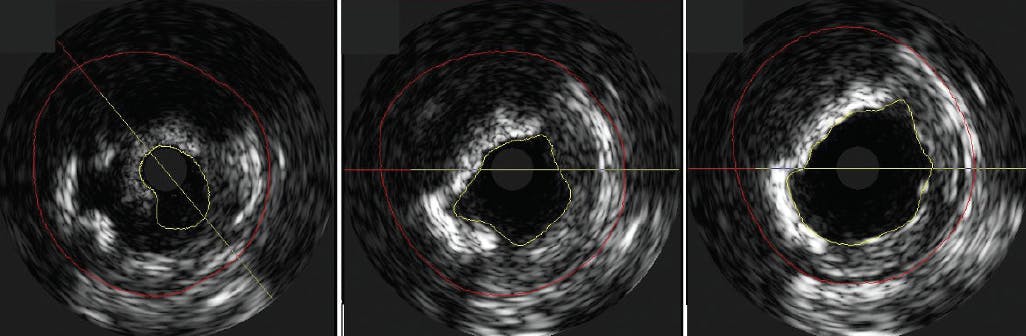
Figure 5. IVUS images of an atherosclerotic lesion comparing baseline with postatherectomy and post-percutaneous transluminal angioplasty apparel.
SUMMARY
EVI of CLI represents a challenge for the endovascular interventionalist. The use of IVUS to guide EVI in CLI appears to be a valuable tool to facilitate decision-making and eventually improve patient outcomes with CLI. Nevertheless, evidence from prospective, perhaps randomized, trials is desperately awaited to support the use of IVUS for EVI in patients with CLI.
1. Fowkes FGR, Rudan D, Rudan I, et al. Comparison of global estimates of prevalence and risk factors for peripheral artery disease in 2000 and 2010: a systematic review and analysis. Lancet. 2013;382:1329-1340. doi: 10.1016/S0140-6736(13)61249-0
2. Hirsch AT, Haskal ZJ, Hertzer NR, et al. ACC/AHA 2005 Practice Guidelines for the management of patients with peripheral arterial disease (lower extremity, renal, mesenteric, and abdominal aortic): a collaborative report from the American Association for Vascular Surgery/Society for Vascular Surgery, Society for Cardiovascular Angiography and Interventions, Society for Vascular Medicine and Biology, Society of Interventional Radiology, and the ACC/AHA Task Force on Practice Guidelines (Writing Committee to Develop Guidelines for the Management of Patients With Peripheral Arterial Disease): endorsed by the American Association of Cardiovascular and Pulmonary Rehabilitation; National Heart, Lung, and Blood Institute; Society for Vascular Nursing; TransAtlantic Inter-Society Consensus; and Vascular Disease Foundation. Circulation. 2006;113:e463-654. doi: 10.1161/CIRCULATIONAHA.106.174526
3. Allie DE, Hebert CJ, Lirtzman MD, et al. Critical limb ischemia: a global epidemic. A critical analysis of current treatment unmasks the clinical and economic costs of CLI. EuroIntervention. 2005;1:75-84.
4. Mustapha JA, Katzen BT, Neville RF, et al. Determinants of long-term outcomes and costs in the management of critical limb ischemia: a population-based cohort study. J Am Heart Assoc. 2018;7:e009724. doi: 10.1161/JAHA.118.009724
5. Dick P, Barth B, Mlekusch W, et al. Complications after peripheral vascular interventions in octogenarians. J Endovasc Ther. 2008;15:383-389. doi: 10.1583/08-2459.1
6. Mintz GS. Clinical utility of intravascular imaging and physiology in coronary artery disease. J Am Coll Cardiol. 2014;64:207-222. doi: 10.1016/j.jacc.2014.01.015
7. Navarro F, Sullivan TM, Bacharach JM. Intravascular ultrasound assessment of iliac stent procedures. J Endovasc Ther. 2000;7:315-319. doi: 10.1177/152660280000700410
8. Krishnan P, Tarricone A, K-Raman P, et al. Intravascular ultrasound guided directional atherectomy versus directional atherectomy guided by angiography for the treatment of femoropopliteal in-stent restenosis. Ther Adv Cardiovasc Dis. 2018;12:17-22. doi: 10.1177/1753944717745509
9. Shammas NW, Torey JT, Shammas WJ, et al. Intravascular ultrasound assessment and correlation with angiographic findings demonstrating femoropopliteal arterial dissections post atherectomy: results from the iDissection study. J Invasive Cardiol. 2018;30:240-244.
10. Panaich SS, Arora S, Patel N, et al. Intravascular ultrasound in lower extremity peripheral vascular interventions: variation in utilization and impact on in-hospital outcomes from the Nationwide Inpatient Sample (2006-2011). J Endovasc Ther. 2016;23:65-75. doi: 10.1177/1526602815620780
11. Lichtenberg M, Stavroulakis K. Do we need IVUS in PAD procedures? Interventional News. 2020;9(suppl):5.
12. Tarricone A, Ali Z, Rajamanickam A, et al. Histopathological evidence of adventitial or medial injury is a strong predictor of restenosis during directional atherectomy for peripheral artery disease. J Endovasc Ther. 2015;22:712-715. doi: 10.1177/1526602815597683
13. Bishop PD, Feiten LE, Ouriel K, et al. Arterial calcification increases in distal arteries in patients with peripheral arterial disease. Ann Vasc Surg. 2008;22:799-805. doi: 10.1016/j.avsg.2008.04.008
14. Baumann F, Fust J, Engelberger RP, et al. Early recoil after balloon angioplasty of tibial artery obstructions in patients with critical limb ischemia. J Endovasc Ther. 2014;21:44-51. doi: 10.1583/13-4486MR.1
15. Mortensen MB, Dzaye O, Steffensen FH, et al. Impact of plaque burden versus stenosis on ischemic events in patients with coronary atherosclerosis. J Am Coll Cardiol. 2020;76:2803-2813. doi: 10.1016/j.jacc.2020.10.021
16. Mitsutake Y, Reifart J, Pyun WB, et al. Differences in vascular response between balloon overstretch and stent overexpansion in nonatherosclerotic porcine coronary arteries. Comp Med. 2017;67:350-355.
17. Hachinohe D, Mitomo S, Candilio L, Latib A. A practical approach to assessing stent results with IVUS or OCT. Methodist DeBakey Cardiovasc J. 2018;14:32-41. doi: 10.14797/mdcj-14-1-32
Advertisement
Advertisement