Advertisement
Advertisement
October 2026 Supplement
Sponsored by Medtronic
Case Study: Liberant™ Thrombectomy to Remove Thrombus From a Stenosed Brachiobasilic AVF

PATIENT PRESENTATION
A male patient in his late 80s with a history of end-stage renal disease, congestive heart failure, and diabetes presented to the emergency department with a malfunctioning arteriovenous (AV) brachiobasilic fistula. Due to his advanced age and comorbidities, his thrombectomy was deferred to the hospital setting. Upon initial examination, we observed that his AV fistula (AVF) was thrombosed. The patient was prepped and draped for fistulography and thrombectomy.
PROCEDURAL DETAILS
Procedural Overview
This AV case required multiple steps to clear the clot. First, to restore blood flow through the clotted dialysis fistula, tissue plasminogen activator (tPA) and the Liberant™ thrombectomy system (Medtronic) were used to remove thrombus from the venous outflow. Further imaging revealed severe narrowing in the outflow, which we addressed with balloon angioplasty and a covered stent. The remaining arterial plug in the arterial connection was disrupted and removed with combination mechanical aspiration thrombectomy.
Outflow Thrombectomy
tPA was administered, and subsequent imaging confirmed mural thrombus within the fistula (Figure 1). We used a 8-Fr Liberant catheter to intervene in the brachiobasilic AVF. The Liberant catheter was advanced initially without a guidewire through the outflow (Figure 2A) using the standard aspiration mode. After two passes, the outflow was completely patent (Figure 2B and 2C). Further imaging revealed > 75% hemodynamically significant stenosis of the outflow vein. This was treated with plain old balloon angioplasty (POBA; 10- X 60-mm EverCross™ PTA catheter; Medtronic) (Figure 3A) and stent placement (10- X 60-mm Covera™* vascular covered stent; BD) (Figure 3B).
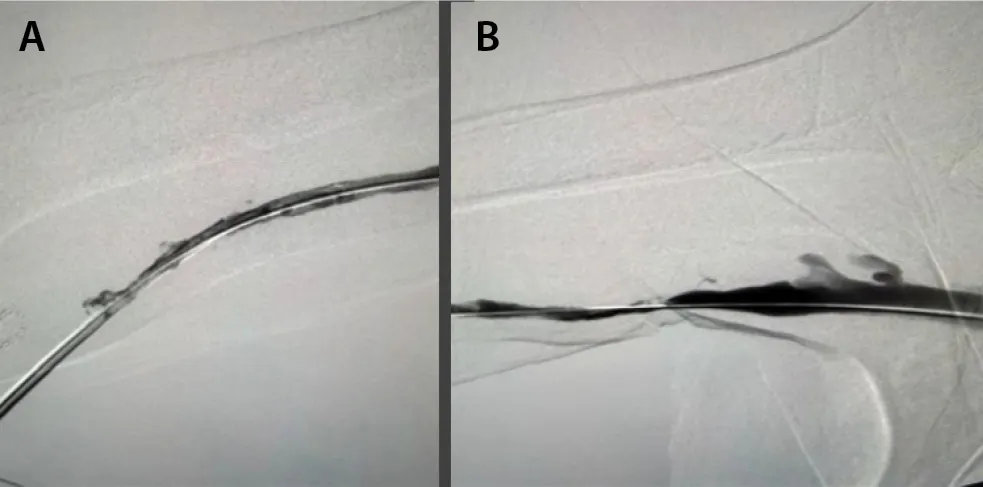
Figure 1. Initial fistulogram demonstrated a brachiobasilic fistula with thrombus (A) and an outflow with severe stenosis (B).

Figure 2. Initial pass with an 8-Fr Liberant catheter without a wire (A) revealed a patent outflow of the brachiobasilic fistula (B) and patent outflow (C).
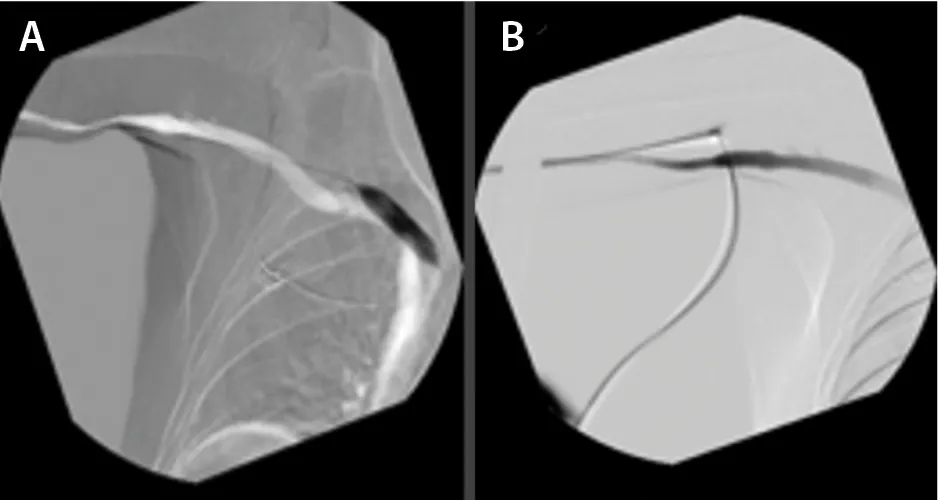
Figure 3. POBA of the axillary vein (A) and a patent axillary vein after angioplasty and stenting (10- X 60-mm Covera) (B).
Inflow Thrombectomy
To treat the inflow, an 8-Fr sheath was advanced toward the brachial artery fistula anastomosis. A 0.014-inch guidewire was advanced into the axillary artery through a Berenstein catheter. The 8-Fr (short) Liberant sheath was then advanced over the wire toward the arterial anastomosis and distally positioned 2 cm from the target vessel connection. Angiography confirmed patent brachial and outflow vessels, and an expected thrombus within the inflow segment of the AVF.
Arterial Plug Thrombectomy
To remove the remaining arterial plug thrombus (Figure 4A), we aspirated with the 8-Fr (short) Liberant catheter in standard mode, and the Excipio™* SV thrombectomy device (Contego Medical) was then advanced into the mid-brachial artery and partially deployed to match the vessel diameter. The device was then used to extract the thrombus. Completion fistulography confirmed thrombus clearance (Figure 4B). Estimated blood loss (EBL) was about 100 mL (Figure 4C).
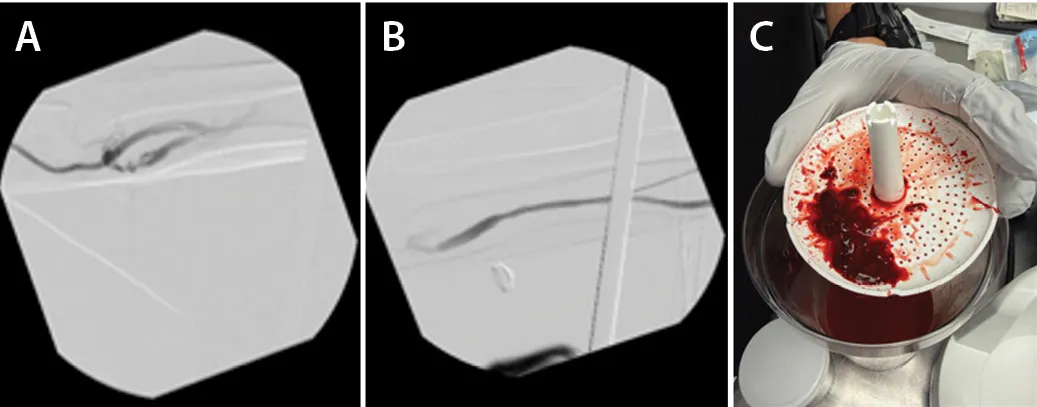
Figure 4. Arterial plug thrombus (A), patent AVF (B), and an EBL of 100 mL in the blood collection canister (C).
Post-Thrombectomy Outcomes
At completion of the case, the patient had a palpable thrill and completed dialysis successfully that day. The Liberant thrombectomy system and Excipio device combine aspiration and extraction technology to remove thrombus successfully from the stenosed AVF.
REFLECTIONS
In this AVF case, a wire was not required for thrombectomy of the outflow since the Liberant catheter tracked well without a wire (Figure 2B). However, a 0.014-inch wire is required for using the Excipio device. In my experience, I typically avoid hydrophilic wires to prevent unnecessary vessel wall gripping.
The Excipio device functions similarly to an over-the-wire Fogarty device. The benefit of Excipio, however, is that it is compatible with aspiration technology, such as the Liberant catheter. This helps achieve removal of thrombus that may not be completely retrieved with suction alone. Care must be taken to ensure size match when advancing the Excipio device through the brachial artery. Of note, the Excipio SV thrombectomy device is compatible with vessels ranging from 4 to 8 mm.
Disclosures: Consultant to Medtronic, Stryker, and Abbott.
Advertisement
Advertisement