Advertisement
Advertisement
September 2026
PAD Endpoints From ATK to BTK: Measuring What Matters
A multidimensional approach to endpoint selection in above- and below-the-knee PAD clinical trials that aims to accurately capture patient-centered, clinically meaningful outcomes.
By William P. Robinson III, MD, FACS, DFSVS, and Lakshmi Dwivedi, MBBS, MPH, MHA
Peripheral artery disease (PAD) affects more than 230 million people worldwide and is a major cause of disability, cardiovascular events, and limb loss. Over the past 3 decades, advances in endovascular therapy have transformed the management of PAD, allowing treatment of increasingly complex lesions.1,2 These endovascular approaches will continue to advance. At the same time, recent randomized trials comparing surgical bypass and endovascular therapy demonstrate that bypass will continue to play an important role in lower extremity revascularization.3 As treatment strategies evolve, the methods used to evaluate and compare their effectiveness must also adapt.
Endpoint selection is a central component of trial design, influencing the evaluation of emerging therapies, comparisons between treatment strategies, and the translation of clinical evidence into practice. In the selection of any endpoint, we must ask the seemingly simple but often elusive question of whether the endpoint adequately reflects the outcomes that matter most to patients and treating clinicians. This article reviews the endpoints traditionally used in PAD studies and clinical trials, discusses their application for above-the-knee (ATK) and below-the-knee (BTK) disease, and considers recent trends in endpoint selection. Finally, we attempt to identify ongoing needs that should guide endpoint selection in future PAD trials.
EVOLUTION OF PAD ENDPOINTS
Historically, PAD trials have focused on procedural success and lesion-based angiographic outcomes, reflecting the primary goals of early device development. Technical success, immediate restoration of blood flow, and residual stenosis were considered reliable indicators of effective treatment. As endovascular technologies matured and follow-up periods became longer, clinicians and researchers recognized that short-term procedural success did not always predict durable clinical benefit. Consequently, vascular patency, freedom from target lesion revascularization (TLR), binary restenosis, and late lumen loss (LLL) became the standard efficacy endpoints (usually measured at 1 year) in many endovascular trials because they provided objective measures of vessel treatment durability.4,5
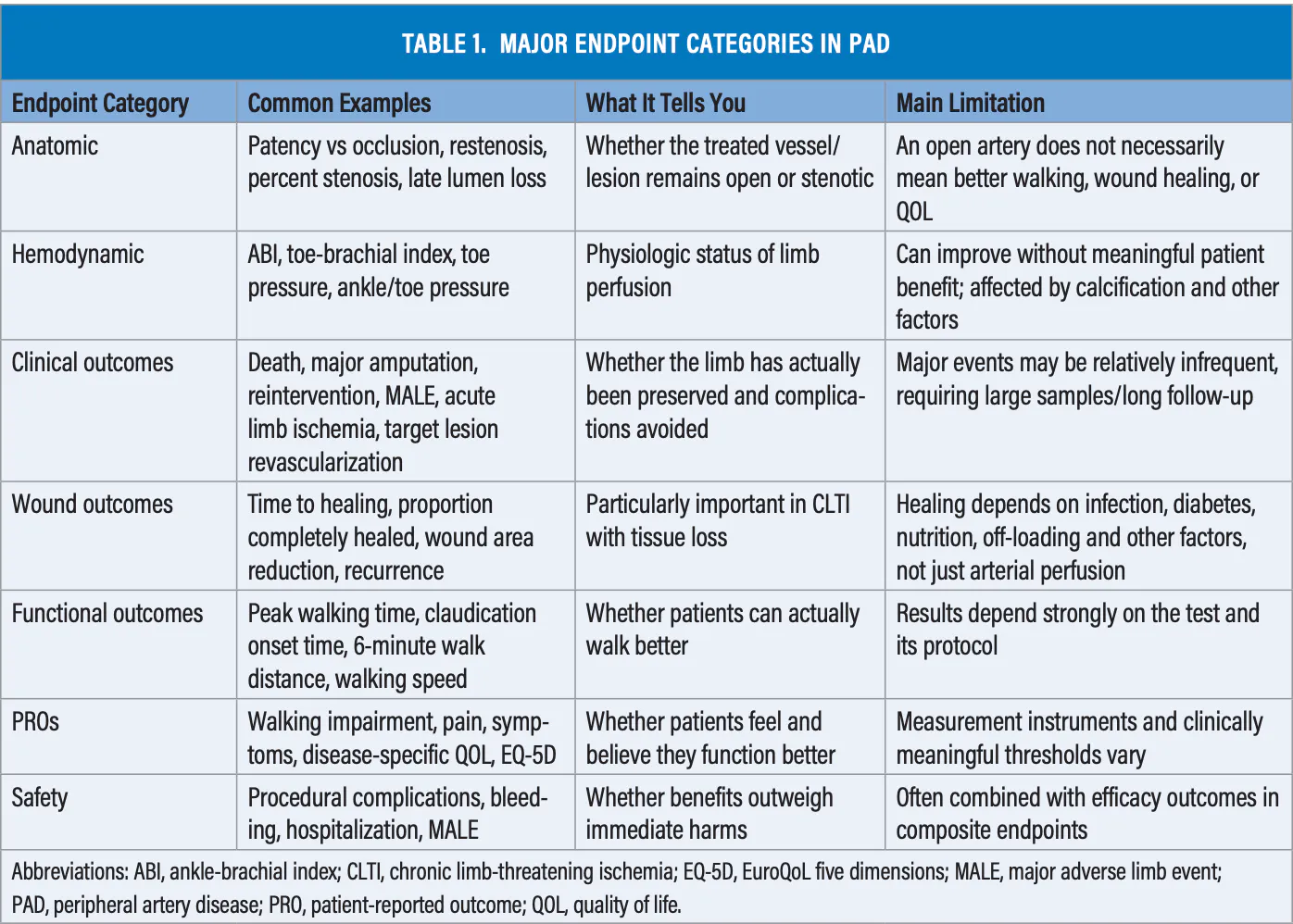
Although these measures remain essential for evaluating the technical performance and durability of an intervention, they do not capture or necessarily translate into meaningful clinical benefit for the patient. One patient may develop restenosis without symptoms, while another may experience persistent pain, nonhealing wounds, or impaired mobility despite maintaining vessel patency. Increasing recognition of these limitations has shifted attention toward endpoints that incorporate objective clinical outcomes, including limb preservation, symptom relief, functional status, and patient-reported quality-of-life (QOL) outcomes, alongside traditional anatomic and procedural measures. Table 1 provides a summary of major endpoint categories.
A MULTIDIMENSIONAL APPROACH TO CLINICAL ENDPOINTS
As PAD research has evolved, it has become apparent that no single endpoint captures treatment success. Treatment success should be evaluated at multiple levels rather than relying on a single outcome measure. The ideal endpoint(s) connects the intervention to an anatomic/biologic effect that translates into patient benefit. Endpoints should address the multiple domains captured in Table 1, which answer different questions and should complement one another. A practical multidimensional framework categorizes endpoints as follows:
- Anatomic/lesion-specific endpoints evaluate the treated arterial segment and primarily assess device performance and procedural durability. These include primary patency, freedom from TLR, binary restenosis, LLL, and angiographic success.
- Hemodynamic endpoints such as ankle-brachial index, toe pressure, pulse volume recordings, and transcutaneous oxygen saturation provide important information on the levels of perfusion and oxygenation perfusion that result from the intervention. Perfusion is related to, but not necessarily synonymous with, the effective restoration of flow through or around the treated vessels.
- Objective clinical endpoints focus on the health of the patient and preservation of the affected extremity. Common measures include mortality, major and minor amputation, major adverse limb event (MALE), wound healing, time to complete wound closure, relief of ischemic symptoms, and resolution of rest pain.
- Functional and patient-reported endpoints include functional capacity and patient-reported outcome measures (PROMs), including health-related QOL. Because they measure how patients perceive their symptoms, mobility, daily activities, and QOL after treatment, they arguably capture what matters most to patients.6 Included in these are instruments such as the Walking Impairment Questionnaire (WIQ), Peripheral Artery Questionnaire (PAQ), Vascular Quality of Life Questionnaire (VascuQoL), and EuroQoL five dimensions.
APPLICATION OF PAD ENDPOINTS TO ATK AND BTK PAD
The clinical objective varies according to the population being treated. Endpoints must therefore be adapted to this clinical objective in the trial population. Patients with ATK occlusive disease differ from those with BTK disease; the indications for treatment differ greatly, as do their clinical objectives. Therefore, a single endpoint strategy may not be appropriate across all PAD populations. The endpoints selected must be tailored specifically for each of these populations.
Endpoint Selection in ATK Disease
Patients with isolated femoropopliteal (ATK) disease most commonly present with intermittent claudication rather than limb-threatening ischemia, at least in the absence of concomitant infrapopliteal disease. Relief from claudication is the clinical goal. Therefore, endpoints that measure patient function have become increasingly important. Traditional endpoints such as primary patency, freedom from clinically driven TLR, binary restenosis, and LLL focused on vessel patency continue to serve as reliable and reproducible measures for comparing the effect of treatment strategies on the treated arteries.5 Long-term follow-up from studies evaluating drug-coated balloons, drug-eluting stents, and other contemporary technologies has reinforced the importance of evaluating anatomic durability beyond the first year.7 However, accumulating evidence suggests that anatomic success alone does not necessarily translate into meaningful clinical improvement. Several studies have demonstrated that patients can experience substantial symptom relief and improved walking ability despite restenosis, while others may require repeat interventions even when imaging demonstrates acceptable vessel patency.8 Therefore, for patients with intermittent claudication, the most common functional endpoints have been treadmill-based walking measures and 6-minute walk distance (6MWD). There is a methodologic debate over treadmill performance versus real-world walking. A treadmill test provides a standardized, reproducible measure and is sensitive to exercise limitation, but it may not represent how a patient actually functions in daily life. The 6MWD is more representative of functional capacity, but it may be less sensitive to some treatment effects.
PROMs are equally important to measure objective limb function, as the indication for intervention is to improve QOL. The CLEVER trial is a good example of using functional outcomes and PROMs.9 The combination of endovascular therapy and supervised exercise produced significantly greater improvements in maximum and pain-free walking distance, as well as VascuQol and 36-Item Short Form Health Survey physical functioning, than exercise alone. This was a very good endpoint strategy because the different measures tell a coherent story: The intervention improved walking performance and therefore improved disease-specific QOL.
In a 2025 analysis of the LITE randomized clinical trial, which compared high- to low-intensity walking and control, endpoints were 6MWD and WIQ patient-reported walking measures.10 High-intensity exercise produced a substantially greater improvement in 6MWD than either low-intensity exercise or control. It also increased the proportion of patients achieving a clinically meaningful improvement in WIQ distance and speed versus control. While these endpoints showed convergent validity, there was also an interesting discordance. High-intensity exercise did not significantly increase the likelihood of achieving the WIQ minimal clinically important difference (MCID) versus low-intensity exercise. This demonstrates that physiologic/functional improvement does not automatically translate into meaningful patient-perceived improvement. Numerous PAD-specific PROMs are available, including the PAQ, VascuQoL, and WIQ. The WIQ is one of the most valuable PAD-specific instruments because it asks patients about walking-related limitations in everyday life. It includes domains such as distance, speed, and stair climbing. It therefore sits somewhere between a pure symptom measure and a functional outcome. Many believe the WIQ has particularly strong evidence across reliability, validity, and responsiveness.
The newly recognized importance of PROMs can be seen in the impact of SWEDEPAD 2 on the 2026 European Society for Vascular Surgery (ESVS) focused update.11,12 SWEDEPAD 2 challenged the assumption that paclitaxel-coated devices provide meaningful patient benefit in claudication, showing no improvement in QOL (as measured by the VascuQoL-6) at 12 months with paclitaxel-coated devices compared to uncoated devices, despite a patency benefit. This, in addition to a concerning 5-year mortality signal, led to a significant revision in the 2024 ESVS recommendation, which was favorable toward paclitaxel-coated balloons in selected patients with a class IIa, level A recommendation for adjunctive paclitaxel-coated balloon angioplasty. The 2026 ESVS focused update cited “limited clinical benefit and possible long-term harm” from paclitaxel-coated devices in intermittent claudication.12
However, inclusion of a PROM does not ensure a good endpoint. A trial can technically include a PROM and still have chosen an instrument that is poorly suited to its population or intervention. Furthermore, not every questionnaire is equally good at detecting treatment-related change. Also, a questionnaire score can change significantly with P < .05 without producing a meaningful difference to patients. It is more valid to determine how many patients achieved a prespecified MCID. The LITE study is a good example because it explicitly incorporated MCIDs for the WIQ and 6MWD. Finally, PROMs are difficult to collect, and this may result in high rates of missing data. A PROM is only useful if it can be reliably collected.
Endpoint Selection in BTK Disease
Endpoint selection becomes more complex in BTK disease because the majority of these patients present with chronic limb-threatening ischemia (CLTI) rather than intermittent claudication. In this population, restoring vessel patency is only one step toward achieving the ultimate goals of therapy, which include wound healing, relief of ischemic pain, preservation of limb function, and prevention of major amputation.2 In view of this, BTK clinical trials focus increasingly on measures such as complete wound healing, limb salvage, freedom from MALE, major amputation, reintervention, and amputation-free survival. These endpoints more accurately reflect the clinical benefit experienced by patients and better align with treatment objectives in CLTI.3 For CLTI, a well-designed trial shows the connection between revascularization, adequate maintenance of perfusion, wound healing, limb preservation, and, ultimately, improved function and QOL.
The BEST-CLI trial is a good example of a strong primary endpoint for a CLTI trial.3 This trial used a composite of MALE or death from any cause, where MALE was defined as above-ankle amputation of the index limb or major index limb reintervention (new bypass, graft revision, thrombectomy, or thrombolysis). This was a significant departure from a traditional device trial in which the primary endpoint might simply be 12-month primary patency. This was a strong choice, as it connected the intervention to outcomes that patients actually care about, including additional procedures, amputation, and death. However, the choice of endpoints does illustrate problems. First, not every death represents failure of the limb intervention, illustrating fundamental tensions in broad patient-oriented clinical endpoints. The more clinically meaningful an endpoint becomes, the more it can be influenced by factors outside the intervention. In addition, BEST-CLI is one of many examples of trials that use composite endpoints to detect a difference between therapies with fewer participants or short follow-up, particularly when outcomes are uncommon. However, composite outcomes have a theoretical problem because they give equal weight to outcomes of differing clinical importance. This has led to increased interest in hierarchical composites and win-ratio/global-rank approaches, which prioritize more serious outcomes. For example, death could rank worse than major amputation, which could rank worse than minor amputation, wound healing, or pain improvement.
Developing standardized BTK endpoints remains challenging for a few reasons. First, the CLTI population is highly heterogeneous, with presentations ranging from rest pain to extensive gangrene requiring multimodal treatments for limb salvage in the setting of multiple competing comorbidities. In addition, wound care, reintervention decisions, and amputation practices often vary among institutions. Consistent wound assessment tools, independent event adjudication, standardized imaging protocols, and validated QOL measures are essential for improving the reliability and comparability of future clinical trials.
In addition, we currently do not have strong measures of functional performance for CLTI patients. As discussed previously, walking ability is a strong endpoint for claudication trials. However, a patient with CLTI may have a number of conditions that prohibit walking other than ischemia: a foot ulcer or gangrene, rest pain, neuropathy, arthritis, frailty, heart failure, prior amputation, and limited mobility preintervention. Preserving function might mean preserving the ability to transfer, walking with a walker, walking in the home, or returning to baseline mobility after wound healing. Novel functional measures are needed to capture the functional benefit of wound healing and limb preservation for CLTI patients. In addition, CLTI-specific instruments for PROMs and standardized definitions remain underdeveloped.
FUTURE DIRECTIONS
Long-term follow-up extending beyond 3 to 5 years is increasingly available to evaluate treatment durability and sustained improvements in functional status and QOL. Future PAD trials should build upon the multidimensional endpoints being used currently, including objective clinical endpoints (including functional outcomes) and PROMs, supported by mechanistic data including anatomic/lesion-specific endpoints and hemodynamic endpoints. However, we would recommend creation of hierarchical, patient-centered composite endpoints as the primary endpoint rather than a conventional “time to first event” composite.
For example, for a CLTI trial, the endpoint would prioritize as follows: death > amputation > major reintervention > wound healing > functional outcome/QOL. This strategy encompasses the majority of events important to the patient but recognizes that they are not equally important. A few such trials in the CLTI/BTK PAD populations are currently underway, including AMBITION BTK, first initiated in the United States and followed by a separately registered European study, and SELUTION4BTK.13-15 For future claudication trials, a hierarchical endpoint for a claudication trial should probably include a combination of VascuQOL, WIQ, 6MWD, treadmill walking distance, clinically driven TLR, and hemodynamic measures. However, additional thought would need to be given to the specific question of interest. Notably, hierarchical endpoints have been used extensively and successfully in cardiology trials.16
Furthermore, the creation of more standardized PROMs and emerging tools like wearable activity monitors, remote wound assessment, and other digital health technologies may provide more accurate and clinically relevant assessments of treatment effectiveness in both clinical trials and routine practice.
SUMMARY
Endpoint selection for PAD trials should reflect a patient’s clinical presentation and the anatomic distribution (ATK vs BTK) of disease. The availability of long-term data renders a tremendous opportunity for patient-centered clinical and functional outcomes and PROMs, while not forgetting the importance of mechanistic data that are important to the effectiveness of the treatment itself. Future strategies in endpoint design and analysis, including hierarchical endpoints, may improve our ability to assess the multiple dimensions important to the effectiveness of any treatment. It may not always be possible to design and collect data on endpoints that are clinically meaningful, statistically efficient, objectively measurable, reproducible across sites, and sensitive to the actual treatment effect. It is important to recognize that not every trial needs every endpoint. Trials themselves can be complementary. Ultimately, the endpoint should be driven by the clinical question, not by a desire to collect every possible measurement.
1. Gerhard-Herman MD, Gornik HL, Barrett C, et al. 2016 AHA/ACC guideline on the management of patients with lower extremity peripheral artery disease: executive summary: a report of the American College of Cardiology/American Heart Association task force on clinical practice guidelines. Circulation. 2017;135:e686-e725. doi: 10.1161/CIR.0000000000000470
2. Conte MS, Bradbury AW, Kolh P, et al. Global vascular guidelines on the management of chronic limb-threatening ischemia. Eur J Vasc Endovasc Surg. 2019;58:S1-S109 e33. doi: 10.1016/j.ejvs.2019.05.006
3. Farber A, Menard MT, Conte MS, et al. Surgery or endovascular therapy for chronic limb-threatening ischemia. N Engl J Med. 2022;387:2305-2316. doi: 10.1056/NEJMoa2207899
4. Schneider PA, Laird JR, Tepe G, et al. Treatment effect of drug-coated balloons is durable to 3 years in the femoropopliteal arteries: long-term results of the IN.PACT SFA randomized trial. Circ Cardiovasc Interv. 2018;11:e005891. doi: 10.1161/CIRCINTERVENTIONS.117.005891
5. Takahashi EA, Lookstein RA, Misra S. Best endovascular versus best surgical therapy in patients with CLI (BEST-CLI) trial: a misleading trial name. J Vasc Interv Radiol. 2023;34:718-719. doi: 10.1016/j.jvir.2023.01.005
6. Hiatt WR, Goldstone J, Smith SC, Jr., et al. Atherosclerotic peripheral vascular disease symposium II: nomenclature for vascular diseases. Circulation. 2008;118:2826-2829. doi: 10.1161/CIRCULATIONAHA.108.191171
7. Rosenfield K, Jaff MR, White CJ, et al. Trial of a paclitaxel-coated balloon for femoropopliteal artery disease. N Engl J Med. 2015;373:145-153. doi: 10.1056/NEJMoa1406235
8. Abdoli S, Katz S, Ochoa C. Long-term patency and clinical outcomes of nitinol stenting for femoropopliteal atherosclerotic disease. Ann Vasc Surg. 2020;66:566-572. doi: 10.1016/j.avsg.2019.11.002
9. Murphy TP, Cutlip DE, Regensteiner JG, et al. Supervised exercise versus primary stenting for claudication resulting from aortoiliac peripheral artery disease: six-month outcomes from the claudication: exercise versus endoluminal revascularization (CLEVER) study. Circulation. 2012;125:130-139. doi: 10.1161/CIRCULATIONAHA.111.075770
10. Whipple MO, Xu S, Zhang D, et al. Home-based exercise and patient-reported outcome measures in peripheral artery disease: the LITE randomized clinical trial. Am J Cardiol. 2025;244:41-47. doi: 10.1016/j.amjcard.2025.02.027
11. Nordanstig J, James S, Andersson M, et al. Paclitaxel-coated versus uncoated devices for infrainguinal endovascular revascularisation in patients with intermittent claudication (SWEDEPAD 2): a multicentre, participant-masked, registry-based, randomised controlled trial. Lancet. 2025;406:1115-1127. doi: 10.1016/S0140-6736(25)01584-3
12. Nordanstig J, Hinchliffe R, Lejay A, Behrendt CA; ESVS Peripheral Arterial Disease Guidelines Writing Committee; ESVS Guidelines Steering Committee. Editor's choice - focused update on paclitaxel coated technologies, from the 2024 European Society for Vascular Surgery (ESVS) guidelines on the management of asymptomatic peripheral arterial disease and intermittent claudication. Eur J Vasc Endovasc Surg. 2026;71:923-927. doi: 10.1016/j.ejvs.2026.04.037
13. Auryon atherectomy system with standard balloon angioplasty versus standard balloon angioplasty alone in Europe (AMBITION BTK). Clinicaltrials.gov website. Accessed August 17, 2026. https://clinicaltrials.gov/study/NCT07472439
14. AngioDynamics. AngioDynamics enrolls first patient in AMBITION BTK trial, advancing treatment for critical limb ischemia. July 28, 2025. Accessed August 17, 2026 https://investors.angiodynamics.com/news-releases/news-release-details/angiodynamics-enrolls-first-patient-ambition-btk-trial-advancing
15. SELUTION4BTK trial. Clinicaltrials.gov website. Accessed August 17, 2026. https://clinicaltrials.gov/study/NCT05055297
16. Pocock SJ, Gregson J, Collier TJ, et al. The win ratio in cardiology trials: lessons learnt, new developments, and wise future use. Eur Heart J. 2024;45:4684-4699. doi: 10.1093/eurheartj/ehae647
Advertisement
Advertisement
