Advertisement
Advertisement
October 2026 Supplement
Sponsored by Medtronic
Treating the Clot in Practice: How Physicians Navigate Thrombus Removal With Mechanical Thrombectomy
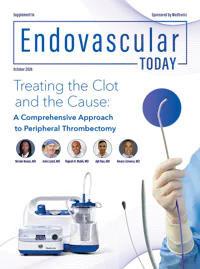
Moderator John Laird, MD, talks with panelists Nicole Ilonzo, MD, and Ajit Rao, MD, about their current approaches to thrombus removal and their thoughts on the recently launched Liberant™ thrombectomy system.

Moderator

Panelists

Managing thrombotic lesions remain one of the most challenging and stressful aspects of vascular practice. Whether it is a swollen, painful leg; an immediately threatened limb in the middle of the night; a thrombosed dialysis access site; or a distally embolized post–proximal thrombotic lesion: vascular specialists continue to seek safer and reliable solutions to high-risk thrombotic cases. There are now numerous commercially available thrombectomy systems for these difficult cases, including mechanical extraction, mechanical aspiration, rheolytics, maceration, and lytic-enhanced systems; however, each has limitations that keep us searching for better options.
Today, I am fortunate to be able to have a discussion with two very busy vascular surgeons, Drs. Nicole Ilonzo and Ajit Rao, about their current approaches to thrombus removal. I will also ask for their thoughts about a newer thrombectomy platform that has the capability to combine mechanical aspiration and extraction to increase our chances of success in even the toughest of cases.
Dr. Laird: There are multiple technologies for treating thrombus. How long have you been incorporating mechanical aspiration thrombectomy devices into your practice? What challenges and limitations have you historically encountered with these devices?
Dr. Ilonzo: I have been incorporating mechanical aspiration thrombectomy into my practice since I began practicing in 2014. I utilize either mechanical aspiration thrombectomy or nitinol-based extraction thrombectomy depending on the clinical scenario. That decision depends on the individual patient, the extent of disease, and the age and characteristics of the thrombus, including whether it is acute, subacute, or wall-adherent.
In my experience, the main challenges with thrombectomy include difficulty navigating devices through acute-on-chronic lower extremity arterial disease, limited effectiveness in removing organized or firmly adherent venous thrombus, and the inability to consistently advance catheters into small distal vessels. Typically, I avoid hydrophilic wires to prevent the devices from becoming stuck when advanced through vasculature. Additionally, the potential for distal embolization is always an important consideration when performing thrombectomies.
Dr. Rao: I am a long-term user of mechanical aspiration thrombectomy since the early generation devices were released into the market in the early 2000s. I believe mechanical aspiration is the sweet spot for thrombectomy given its versatility, excellent thrombus extraction, and ability to treat complex anatomy in a single session without need for lytic therapy. Limitations of the technology traditionally include removal of more chronic or organized thrombus.
Dr. Laird: Can a single thrombectomy device effectively address arterial, venous, and arteriovenous fistula (AVF) use cases, or do you prefer different tools depending on the scenario?
Dr. Ilonzo: I prefer different tools for different scenarios. I have been fortunate to have exposure to a large gamut of thrombectomy devices, so I know what works quickly and efficiently depending on the patient and depending on the pathology.
Dr. Rao: In general, no single device or approach can treat all anatomy and clinical scenarios. However, I believe mechanical aspiration thrombectomy is the most versatile approach and is my go-to device. I can utilize this technology for the vast majority of all thrombectomy cases.
Dr. Laird: Medtronic recently launched the Liberant™ thrombectomy system. What key differences have you noted with Liberant compared to other mechanical aspiration thrombectomy systems?
Dr. Ilonzo: The Liberant thrombectomy system met my expectations of safety and performance—it tracks well and efficiently removes thrombus. The compatibility of the Excipio™* thrombectomy device (Contego Medical) is an added benefit of the Liberant system. It adds a mechanical component to an aspiration case, which raises the possibilities for procedural effectiveness and efficiency when it comes to treating patients with thrombotic disease.
Dr. Rao: My experience with the Liberant thrombectomy system has been very positive. The device offers a unique selection of catheter choices to treat nearly any anatomy encountered. I have found notable attributes of the Liberant device, including its trackability due to the dilator that comes with the kit, ability to easily torque the device, and the option to use the Excipio device to disrupt adherent and mural thrombus.
Dr. Laird: Can you describe how the Liberant catheter performs in terms of torque response and deliverability and how that influences your ability to reach and navigate target vessels?
Dr. Ilonzo: I have used the various sizes—6 Fr, 8 Fr, and 12 Fr—and have not had issues with kinking. The ease of navigation through challenging vasculature allows for atraumatic access with good angular maintenance while advancing through target vessels.
Dr. Rao: Noteworthy strengths of the Liberant catheters include the deliverability of the device with the dilator and torque response. I can navigate and track the catheter through tortuous anatomy and bifurcations with ease.
Dr. Laird: What factors influence your decision to use the Excipio thrombectomy device, and what is your preferred technique for the combined use of Liberant and Excipio?
Dr. Ilonzo: Excipio is very useful to me, especially if I am doing a mechanical aspiration case where there is extensive thrombus. Having the opportunity at my practice for first-hand experience with new devices has shaped my preferences, especially with hands-on training.
Dr. Rao: I believe Excipio is a useful adjunct to the Liberant catheter, which I selectively use in thrombectomy cases. Specifically, I use Excipio in conjunction with the Liberant catheter to help disrupt thrombus and remove adherent mural thrombus that does not clear with aspiration alone. The combination of the expandable Excipio basket and Liberant aspiration improves procedural efficiency, allowing me to devote more time to patient counseling, care coordination, and follow-up planning.
Dr. Laird: The blood conservation unit (BCU) leverages ultrasonic controlled thrombectomy. Have you experienced less blood loss with Liberant compared to alternative aspiration thrombectomy systems? Do you have a preference or treatment algorithm for standard versus boost mode, and how does it vary by vessel bed?
Dr. Ilonzo: It is important to be mindful of estimated blood loss throughout the case to avoid losing more blood than necessary. The Liberant system has comparable blood loss relative to existing aspiration systems. I rarely use boost mode because I can quickly complete the thrombectomy with standard mode alone in most cases.
Dr. Rao: The BCU has been effective at reducing blood loss by automatically adapting the aspiration power. My algorithm is to start on standard mode and selectively use boost mode in segments with a large degree of thrombus burden. I find that I am more often utilizing boost mode in larger vessels such as the iliac artery and iliac vein when there is occlusive thrombus.
Dr. Laird: Do you have any closing remarks to add for the readers?
Dr. Ilonzo: Thrombectomy is rarely an elective case, and every thrombectomy catheter has nuances that are unable to be learned by just one initial use. Therefore, getting familiar with a thrombectomy system in an emergency setting is never ideal. I found that AV access thrombectomy has been a good way to see the benefits of the Liberant system in a lower-intensity setting. I have seen how the 8-Fr catheter platform works in removing thrombus with just a couple of passes. I have used the Liberant and Excipio devices to help remove wall-adherent thrombus in AV grafts that have been thrombosed for longer than usual. Indeed, there is some maneuvering the Excipio length mismatch to the short 8-Fr sheath for AV access thrombectomy, but the torqueability of the Liberant catheter makes this achievable in challenging anatomy. Overall, in my thinking, where the thrombectomy experience gets a bit more novel and interesting is how one can incorporate nitinol extraction with aspiration.
Dr. Rao: The Liberant device is a great addition to the thrombectomy space and has several noteworthy strengths, including trackability, ease of torque, and the use of combination therapy with Excipio. These new tools have allowed me to treat challenging anatomy and cases with a large degree of thrombus burden in a single session.
CLOSING REMARKS FROM DR. LAIRD
Thank you both for these valuable insights. It is exciting to hear that this combination of mechanical aspiration thrombectomy with a disruption device plays such an important role in your clinical practice and allows you to treat these tough cases more safely and quickly. My takeaways from this discussion are that the Liberant catheters are deliverable in difficult anatomy, kink resistant, and more easily torqueable. The combination of the Liberant and Excipio devices provide enhanced capability to disrupt and remove fresh as well as wall adherent thrombus. The combination of these two platforms addresses many of the limitations of other commercially available thrombectomy devices.
Advertisement
Advertisement