Advertisement
Advertisement
October 2026
Sponsored by Boston Scientific Corporation
The Value of Durability in Peripheral Artery Disease
Experts discuss how treatment durability can influence patient outcomes, health care utilization, and costs.
When evaluating treatment value in peripheral artery disease (PAD), the upfront cost of a procedure is often the most visible metric. Yet, for many patients, the greater burden emerges when treatment durability is not achieved. As illustrated in Figure 1, loss of patency and restenosis may initiate a cascade of downstream events that extend well beyond the index procedure, driving additional health care utilization, and increasing patient burden.
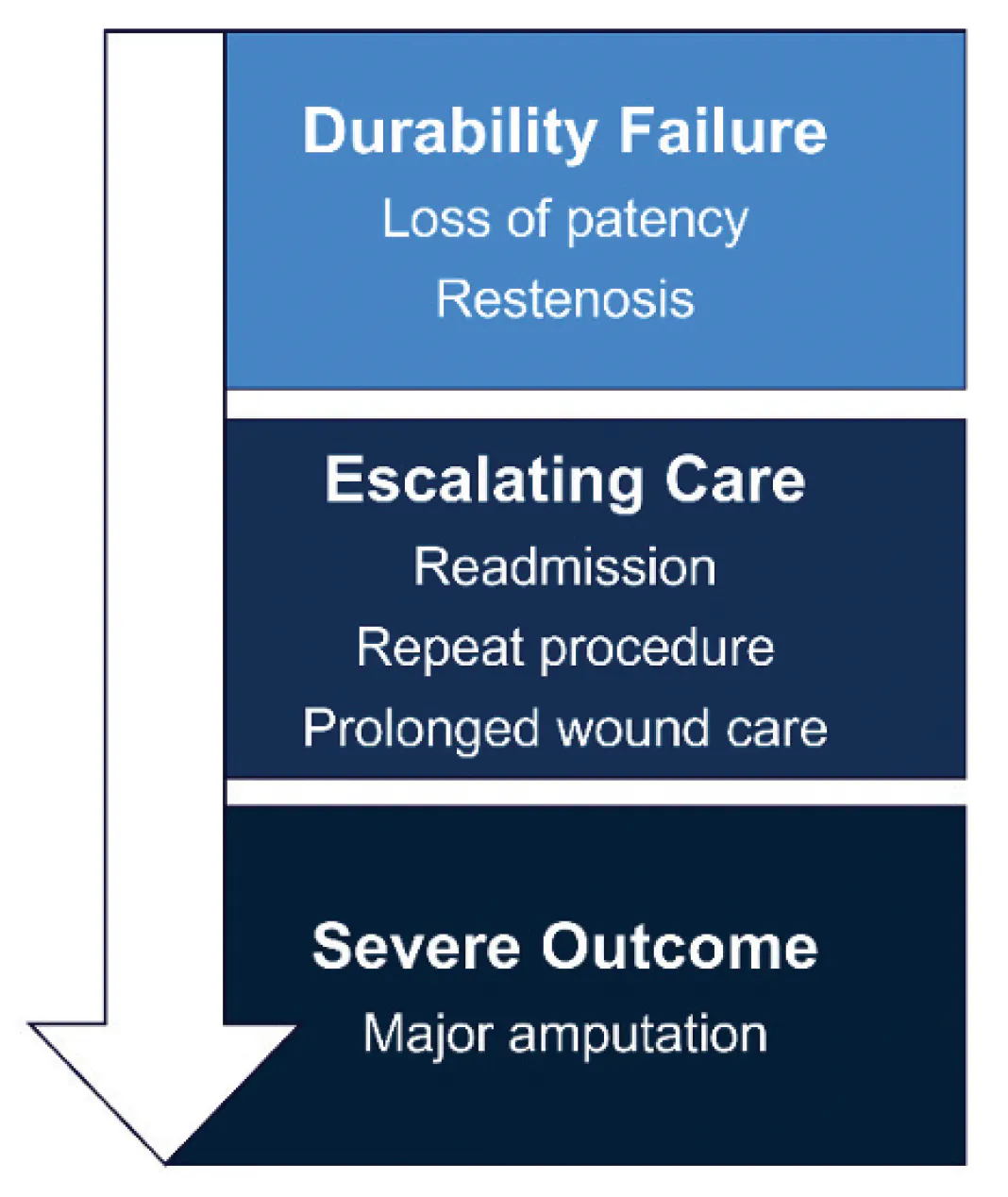
Figure 1. Cascade of durability failure. Loss of durability can lead to other complications, ultimately increasing patient burden and health care utilization.
In this article, Drs. Anahita Dua and Zola N’Dandu discuss how treatment durability in PAD can influence patient outcomes, health care utilization, and costs.


How should physicians define value when evaluating drug-eluting technologies today?
Dr. Dua: Value should be defined by the outcomes that matter most to patients. While traditional measures such as patency and target lesion revascularization (TLR) remain important, patients really care about whether they keep their limb, stay out of the hospital, heal their wounds, and maintain their independence and quality of life (QOL).
This is how I think we should evaluate drug-eluting technologies. If a therapy delivers more durable patency, reduces the need for repeat procedures, and lowers the risk of amputation, then it is providing meaningful value for both the patient and health care system.
We are also starting to see real-world evidence support that perspective. Large data sets, including the recent TRUVETA analyses of over 10,000 patients, demonstrate that above-ankle amputation and readmissions occurred significantly less frequently for patients receiving drug-eluting therapies.1 Specifically, treatment with a non–drug-eluting device increased odds for any amputation by 30% and increased odds for readmission by 7%.1 Those are the outcomes that should drive the value discussion.
Dr. N’Dandu: When I think about value in the context of endovascular treatment, I always start with the patient. Our goal is not simply to perform a technically successful procedure. The real goal is to provide a therapy that is durable, long-lasting, and keeps patients well over time. When we treat patients with PAD, particularly those with chronic limb-threatening ischemia (CLTI), we are trying to accomplish several things simultaneously. We want symptom resolution. We want wound healing when wounds are present. We want to preserve limbs. But, perhaps most importantly, we want patients to return to their lives and remain free from recurrent events that bring them back into the health care system. That is where I see the value of drug-eluting technologies. For many patients with claudication, that means being able to walk farther, remain active, and participate in the daily activities that matter most to them. When restenosis occurs and symptoms recur, those gains can be lost, negatively affecting mobility, independence, and QOL.
Multiple trials, such as IMPERIAL, EMINENT, and real-world registries, show that these therapies provide primary patency in the range of 90% and reduce the need for repeat interventions.2-4 By decreasing TLR and improving durability, we increase the likelihood that patients heal appropriately and maintain their independence. Ultimately, value is measured by our ability to keep patients doing well after they’ve left our procedure suite.
What economic consequences of restenosis are frequently overlooked?
Dr. N’Dandu: Many people underestimate the true cost of repeat interventions. Every time a patient returns for another procedure, there are significant downstream consequences. It is another procedure. Another visit to an office-based lab, ambulatory surgery center, or hospital, which translates into more devices, more staffing, more copays, and more facility resources. Those costs add up quickly. What often gets overlooked, however, is the impact beyond the procedural costs themselves. Most importantly, patients remain dependent longer. One of our goals should be helping patients maintain their independence. When treatment durability is inadequate, patients can become trapped in a cycle of recurrent procedures, recurrent health care visits, and prolonged disability. If we can provide a durable solution upfront, we can dramatically improve their QOL.
Dr. Dua: The cost of restenosis extends far beyond the repeat procedure itself. One of the most overlooked and significant factors is the cost associated with prolonged wound care. Patients require frequent nursing visits, dressing changes, specialty consultations, and ongoing care while wounds remain open. If you have a patient and if it costs $100,000 to manage a wound over 6 months, and delayed healing extends that timeline by another 6 months, those costs can quickly double. If a more durable therapy can shorten that healing time by even a few months, the downstream savings become significant.
Restenosis can prolong wound care, increase health care utilization, add transportation and caregiver burden, and delay a patient’s return to normal life. The intervention and the wound should not be viewed separately, they are intimately connected.
How do durability and freedom from reintervention influence your treatment decisions?
Dr. Dua: Durability is fundamental because every reintervention has consequences, and it is not just another procedure on a schedule. Durable revascularization gives the wound time to heal and gives the multidisciplinary team a chance to succeed. You can have excellent wound care, podiatry, and vascular medicine support, but none of that can compensate for an intervention that fails early. The underlying treatment must be durable.
Dr. N’Dandu: It is a big part of our decision-making tree. Very much like cancer. Our oncology colleagues want to treat patients and keep them in remission. That should be our goal as well. We should treat patients aggressively upfront with guideline-directed medical therapy, and for those who need revascularization, offer treatment options that keep them out of our operating rooms and angiography suites.
Has the conversation around PAD economics evolved over the last decade?
Dr. N’Dandu: It is improving, but we still have a long way to go. When you look at a lot of our clinical trials, sometimes the endpoints do not match what we actually do in day-to-day life. Sometimes we focus on restenosis, TLR, or patency. Maybe we should look at endpoints like freedom from amputation and whether a patient can live an independent life. We should start looking at some of these endpoints when we talk about economics.
Dr. Dua: It has evolved, but I think we continue to avoid the most important question: What does success actually look like in PAD? As a field, we have never fully aligned the outcomes and metrics that matter most. One study measures patency. Another measures TLR. Another focuses on restenosis or mortality. Those endpoints may be important scientifically, but the patient is asking a much simpler question: “Am I going to keep my leg?” Oncology does not evaluate care only by asking whether a particular drug produced a technical response. The field has agreed on meaningful outcomes and holds health care systems and programs accountable for them. PAD needs the same level of clarity. Until we define success, we'll continue having the same conversation about cost, value, and access.
What outcomes should health care systems be measuring when assessing value?
Dr. Dua: A technically successful procedure is not enough if the patient continues through months of wound care, returns for another intervention, or ultimately undergoes an amputation. Health care systems should know their limb preservation and amputation outcomes. Physicians should also be able to understand how their patients perform beyond their own hospital or practice. Without shared metrics, it is very difficult to know whether we are truly delivering better care.
Dr. N’Dandu: We should start looking at the bigger picture. Sometimes we get focused on one provider or one hospital system. What we should really be looking at is the impact of therapies on reducing amputations and CLTI, not just in one hospital system but across entire regions. That means implementing multidisciplinary team approaches.
One major lesson from vascular care over the last decade is that successful treatment cannot occur in silos. Patients do best when multiple disciplines work together. This includes vascular surgeons, interventional cardiologists, interventional radiologists, podiatrists, wound care teams, and primary care providers, and we have data supporting multidisciplinary teams. Ancillary analyses from BEST-CLI showed that high-volume multidisciplinary teams perform better and have lower amputation rates.5 This is very similar to transplant or left ventricular assist device programs. High-volume centers that routinely perform complex procedures generally achieve better outcomes because of experience, infrastructure, and coordinated care pathways.
What are the real-world consequences of reinterventions for patients?
Dr. N’Dandu: The consequences extend far beyond cost. Each additional intervention increases procedural risk. Even though complications may be uncommon, when a complication occurs, it is 100% significant to that patient. There is also the emotional burden of repeated procedures, the uncertainty, the disruption to daily life, and the ongoing dependence on health care services. At the same time, the health care system incurs costs and resource utilization. Repeat interventions consume finite resources that could be used to treat another patient waiting for revascularization.
Another aspect we rarely discuss is provider burden. As interventionalists, we face radiation exposure, ergonomic challenges, and musculoskeletal strain from long and complex procedures. Reducing repeat interventions benefits not only patients but providers, too.
Dr. Dua: I do not think most people appreciate the sheer burden these patients are already carrying. A patient with CLTI may be attending wound care several times a week while also seeing vascular specialists, podiatry, cardiology, diabetes care, and other services. That is just for the leg, before we consider everything else that may be happening medically or personally.
Many of these patients do not have reliable transportation. They may not have money for repeated trips, time away from work, or a family member who can keep bringing them to appointments. Unlike many cancer programs, PAD care often does not include a navigator who coordinates the entire journey.
Reintervention is therefore not an isolated event; it adds to an already overwhelming care burden and may restart the cycle of appointments, procedures, recovery, and wound management. At the very least, when we have a patient in front of us, we should use that opportunity to provide the most durable treatment possible.
How are advances in technology shaping clinical decision-making, and do current payer frameworks adequately recognize differences in therapeutic mechanisms of action?
Dr. Dua: The evidence supporting drug-eluting technologies is increasingly difficult to ignore. We have randomized trials such as IMPERIAL, EMINENT, and SPORTS showing superiority of Eluvia™ drug-eluting stent (Boston Scientific Corporation) compared to bare-metal stents and other paclitaxel-based stents.2,3,6 There are registries and real-world analyses showing more durable outcomes and fewer repeat interventions.7 The other point we sometimes overlook is that preserving patency helps preserve mobility. If patients can continue to walk and remain active after revascularization, they’re better positioned to manage their overall cardiovascular health, including weight, blood pressure, cholesterol, and diabetes and have an improved sense of self. The technology is not simply doing the same thing at a different price. It is addressing the biological process that contributes to restenosis.
The challenge is that payer frameworks do not always recognize that distinction. But I do not think the fundamental problem is a lack of data. The problem is that PAD has not created enough accountability around the outcomes that the technology is intended to improve.
Payers respond to clearly defined outcomes, public expectations, and established standards of care. PAD does not yet have the same visibility or outcome-based accountability. For example, it’s more expensive to perform a procedure with anesthesia than without anesthesia, but there’s a reason we don’t ask patients to bite down on a stick while we operate. We accept that added cost because it leads to a better, safer, and more humane patient experience.
If we want models to recognize the value of drug-eluting therapies, we need to communicate in terms that matter to the public. Saying that one device has better patency than another is not enough; we need to start talking about what patency actually delivers. That is the story the PAD community needs to tell more clearly.
Dr. N’Dandu: Technology continues to advance, and the clinical evidence supporting these therapies continues to grow.
The evidence consistently demonstrates that drug-eluting therapies reduce restenosis, reduce TLR, and improve patency. Those advantages increase our chances of getting patients to the finish line: wound healing, limb preservation, and long-term independence. For complex lesions, particularly long and heavily calcified lesions, balloon angioplasty alone may not always be enough. In those cases, drug-eluting stents offer two important benefits. First, they provide scaffolding to address recoil. Second, they provide antiproliferative drug therapy to address neointimal hyperplasia. That combination is beneficial in maintaining patency and minimizing clinically driven repeat revascularizations.
However, if I were to identify the biggest challenge facing our patients today, it would not be technology—it would be access to care. We can develop increasingly sophisticated devices and generate increasingly compelling data, but if patients cannot access those therapies, then the impact is limited. Large portions of this country still lack adequate access to vascular specialists. There are patients living in rural communities or underserved areas who simply do not have access to the treatments we know are effective.
We have seen that great outcomes are possible in traditionally underserved populations when we make a deliberate effort to reach those patients and include them in our studies. I have seen this firsthand as an investigator in the ELEGANCE registry, where intentional engagement of community-based investigators and historically underrepresented patient populations demonstrates that meaningful clinical outcomes are achievable across diverse patient groups.7 Efforts like these help ensure that the evidence guiding PAD care reflects the patients we see in everyday practice.
I believe discussions about innovation must also include discussions about access. Advancing technology is important. Expanding access is equally important.
1. Brodmann M. TRUE-PTX: The study of drug-eluting vs bare device therapies for PAD in the real world: 12-month amputation and readmission rates in a large population. Presented at: Leipzig Interventional Course (LINC) 2025; January 28, 2025; Leipzig, Germany.
2. Gouëffic Y, Torsello G, Zeller T, et al. Efficacy of a drug-eluting stent versus bare metal stents for symptomatic femoropopliteal peripheral artery disease: primary results of the eminent randomized trial. Circulation. 2022;146:1564-1576. doi: 10.1161/CIRCULATIONAHA.122.059606
3. Gray WA, Keirse K, Soga Y, et al. A polymer-coated, paclitaxel-eluting stent (Eluvia) versus a polymer-free, paclitaxel-coated stent (Zilver PTX) for endovascular femoropopliteal intervention (IMPERIAL): a randomised, non-inferiority trial. Lancet. 2018;392:1541-1551. doi:10.1016/S0140-6736(18)32262-1
4. Gray WA; on behalf of the IMPERIAL investigators. 2-year outcomes from the IMPERIAL randomized head-to-head study of Eluvia DES and Zilver PTX. Presented at: Leipzig Interventional Course (LINC) 2020; January 28-31, 2020; Leipzig, Germany.
5. Jones DW, Farber A, Armstrong DG, et al. Characteristics of multidisciplinary limb preservation teams and their impact on outcomes in the BEST-CLI trial. J Vasc Surg. 2026;83:528-538. doi: 10.1016/j.jvs.2025.08.028
6. Tepe G. SPORTS trial: Drug eluting stent or primary bare nitinol stent application versus drug coated balloons in long SFA lesions. Presented at: Charing Cross International Symposium; London, United Kingdom; April 23-25, 2025.
7. Secemsky EA. 12-month outcomes for patients with complex PAD treated with Eluvia DES from the ELEGANCE registry. Presented at: Vascular InterVentional Advances (VIVA) 2026; October 6, 2026; Las Vegas, Nevada.
Disclosures
Dr. Dua: Speakers bureau, Boston Scientific Corporation.
Dr. N’Dandu: Advisory board, Provisio; consultant, Abbott, BD, Boston Scientific, LimFlow (Stryker); research, Aveera, Boston Scientific, RV3, BD, Stryker; speakers bureau, Abbott, BD, Boston Scientific, Endologix.
Durability Failure After PAD Intervention Can Lead to an Increased Burden on Patients and the Health Care System
Patients with unmanaged disease or revascularization failure often require intensified surveillance, repeat interventions, hospital readmissions, prolonged wound management, and, in severe cases, major amputation. These consequences can affect not only health care expenditures but also mobility, independence, and QOL for patients. Successful endovascular revascularization may prevent these consequences, with durable treatment further postponing detrimental outcomes.
The economic implications of this cascade are substantial. In the multinational COSTLY-TLR study, investigators examined 482 femoropopliteal TLR procedures and found that repeat interventions were associated with considerable procedural and periprocedural costs.1 Mean costs exceeded €21,000 per TLR episode, with procedure duration emerging as the primary driver of expense. Importantly, more than 40% of patients required intensive care unit admission following TLR, underscoring that reintervention is rarely a benign event.
The burden extends with additional treatment needs that emerge along the cascade of treatment failure. Recent health economic analyses of real-world evidence demonstrated that reinterventions and major amputations after lower extremity endovascular treatment are associated with substantial health care costs (endovascular reintervention: mean $20,808; major amputation: mean $38,060).2,3 Together, these findings suggest that the financial consequences of treatment failure accumulate across the entire patient journey, rather than at a single point in time.
For this reason, treatment durability has become increasingly relevant when assessing value in PAD. Clinical evidence suggests that drug-eluting technologies, such as Eluvia drug-eluting stent or Ranger™ drug-coated balloon (Boston Scientific Corporation), are associated with higher patency, fewer reinterventions, lower rates of readmission, and lower risk of major amputation compared with nondrug technologies (Figure 2).4-9 By reducing the likelihood of entering the durability-failure cascade, these technologies may offer economic value that extends beyond device acquisition cost and may help lessen long-term burden on both patients and health care systems.
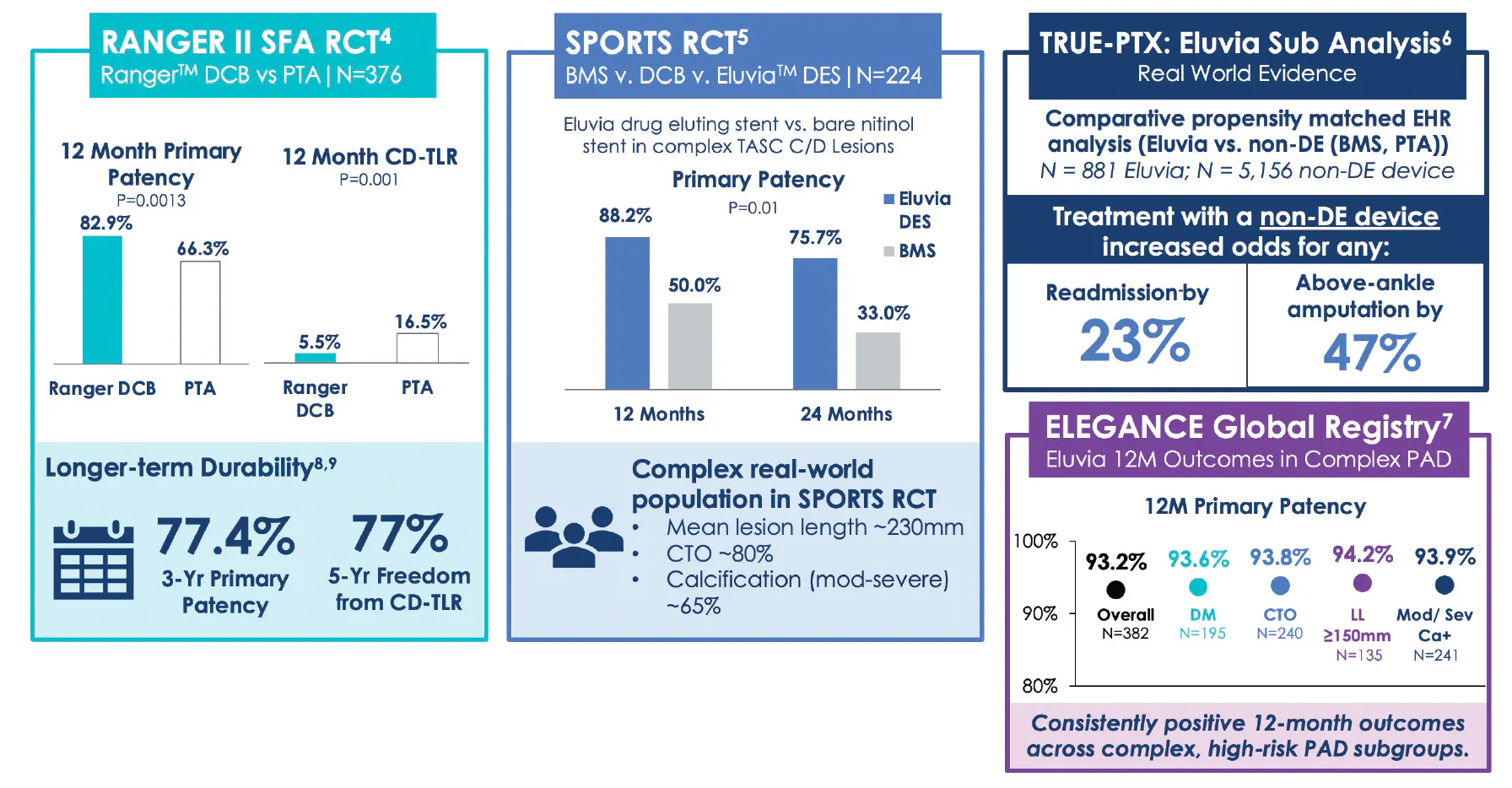
Figure 2. Clinical evidence demonstrates durable outcomes with drug elution. Across randomized controlled trials, registry and real-world evidence, drug-eluting therapy results in improved patency, fewer reinterventions, and is associated with lower adverse downstream outcomes. CTO, chronic total occlusions; DM, diabetes mellitus; LL, long lesions; PTA, percutaneous transluminal angioplasty. All patency and CD-TLR are KM estimates.
1. Saratzis A, Torsello GB, Cardona-Gloria Y, et al. Cost analysis of target lesion revascularisation in patients with femoropopliteal in stent re-stenosis or occlusion: the COSTLY-TLR study. Eur J Vasc Endovasc Surg. 2024;68:100-107. doi: 10.1016/j.ejvs.2024.02.001
2. McGovern AM, Janinis V, Anderson N, et al. Economic burden of lower extremity endovascular reintervention in patients with peripheral artery disease: a real-world cost analysis. Value Health. 2026;29:S163. doi: 10.1016/j.jval.2026.03.822
3. McGovern AM, Janinis V, Anderson N, et al. Cost of amputation following lower extremity endovascular revascularization in peripheral artery disease. Value Health. 2026;29:S62. doi: 10.1016/j.jval.2026.03.297
4. Sachar R, Soga Y, Ansari MM, et al. 1-year results from the RANGER II SFA randomized trial of the Ranger drug-coated balloon. JACC Cardiovasc Interv. 2021;14:1123-1133. doi: 10.1016/j.jcin.2021.03.021
5. Tepe G. SPORTS trial: Drug eluting stent or primary bare nitinol stent application versus drug coated balloons in long SFA lesions. Presented at: Charing Cross International Symposium; London, United Kingdom; April 23-25, 2025.
6. DeRubertis BG. Polymer-based drug-eluting stent vs bare device therapies for PAD in the real world: 12-month amputation and readmission rates in a large population. Presented at: Charing Cross International Symposium; London, United Kingdom; April 23-25, 2025.
7. Secemsky EA. 12-month outcomes for patients with complex PAD treated with Eluvia DES from the ELEGANCE registry. Presented at: Vascular InterVentional Advances (VIVA) 2026; October 6, 2026; Las Vegas, Nevada.
8. Brodmann M. 5-year safety of the Ranger drug-coated balloon in the RANGER II SFA randomized trial. Presented at: Leipzig Interventional Course (LINC) 2024; May 28-31, 2024; Leipzig, Germany.
9. Brodmann M. RANGER II SFA: 3 year patency and 4 year clinical safety. Presented at: Leipzig Interventional Course (LINC) 2023; June 6, 2023; Leipzig, Germany.
Advertisement
Advertisement